

Fertilizers Regulations 1993
I, the Governor in and over the State of Tasmania and its Dependencies in the Commonwealth of Australia, acting with the advice of the Executive Council, hereby make the following regulations under the Fertilizers Act 1993 .
2 November 1993P. H. BENNETT
Governor
By His Excellency's Command,
ROBIN GRAY
Minister for Primary Industry and Fisheries
PART 1 - Preliminary
These regulations may be cited as the Fertilizers Regulations 1993 .
These regulations take effect on 1 December 1993.
In these regulations –Act means the Fertilizers Act 1993 ;animal material includes material such as blood, bone, fish, animal flesh and feather meal;effective neutralizing value means the effective neutralizing value as calculated in accordance with regulation 4 ;foliar application means application to the foliage of a plant;lime means a substance which contains calcium carbonate, magnesium carbonate, calcium oxide or magnesium oxide and which is used –(a) to increase the pH of soil; or(b) as a soil conditioner; or(c) as a fertilizer;neutralizing value means the value equivalent to the amount of acid neutralized by an amount of fertilizer expressed as a percentage of the amount of acid neutralized by an equal amount of calcium carbonate;phosphatic fertilizer means a fertilizer of which more than 2% is phosphorus;plant material includes any material which forms part of a plant;soil conditioner means a product used to alter the physical, chemical or biological characteristics of soil;tolerance means the amount, expressed as a percentage, by which a characteristic of a fertilizer set out in Schedule 3 may vary from the value of that characteristic stated on the label, invoice or delivery docket;trace element fertilizer means a fertilizer mainly intended to supply one or more of the following:(a) iron;(b) manganese;(c) copper;(d) zinc;(e) boron;(f) molybdenum;(g) cobalt;(h) chlorine;(i) selenium.
4. Effective neutralizing value
Effective neutralizing value is calculated in accordance with the following formula:where –A is the effective neutralizing value; andB is the proportion of weight of lime of particle size not greater than 300 µm; andC is the proprotion of weight of lime of particle size greater than 300 µm but not greater than 850 µm; andD is the proportion of weight of lime of particle size greater than 850 µm; andE is the neutralizing value of lime.

PART 2 - Labelling
(1) A person must not sell a fertilizer, other than a custom fertilizer mixture, unless the package in which it is contained has a label stating the following details:(a) the name of the fertilizer;(b) the concentration and form of each constituent of the fertilizer;(c) the quantity of fertilizer within the package;(d) any required warnings;(e) the name and place of business of the manufacturer or wholesaler.Penalty: Fine not exceeding 20 penalty units.(2) A label for a custom fertilizer mixture is to state the ingredients in the mixture and their proportions by weight.(3) Subject to subregulation (4) , a label is to be printed or stencilled on the package or securely fixed to the outside of the package.(4) In the case of bulk fertilizers or a custom fertilizer mixture, if a label can not be attached to the package, the label is to be attached to, or form part of, the invoice or delivery docket.
6. Invoices for bulk fertilizers and custom fertilizer mixtures
(1) The seller of a bulk fertilizer or a custom fertilizer mixture is to ensure that the invoice or delivery docket in relation to the fertilizer is –(a) handed to the purchaser or person authorized by the purchaser; or(b) left at the place of dealing in a safe and conspicuous place; or(c) posted to the purchaser.(2) If the invoice or delivery docket is left in accordance with subregulation (1)(b) , the seller is to post a copy of the invoice or delivery docket to the purchaser within 14 days of the delivery of the fertilizer.
(1) Printing on any label, invoice or delivery docket is to be –(a) in English; and(b) clearly legible; and(c) indelible; and(d) in a colour which affords a distinct contrast to the background colour; and(e) proportional to the size of the label, invoice or delivery docket but not less than 1.5 mm high in the case of capital letters, and 1.0 mm high in the case of lower case letters.(2) Information that is printed on a label, invoice or delivery docket in English may be repeated on the label or invoice in another language.(3) If a fertilizer is sold in a package, the printing is to be on the outside face of the package.
(1) A fertilizer is to be named so as to make the fertilizer easily distinguishable from all other fertilizers.(2) The name of a fertilizer is to include the manufacturer's name if a constituent or ingredient of the fertilizer is used as part of the name.(3) The name of the fertilizer is not to be inappropriate or misleading.(4) The proportion of an ingredient in a fertilizer is not to be represented by numbers in the name.(5) If the concentrations of nitrogen, phosphorus and potassium are included in the name of a fertilizer, the concentrations are to be in the following order:(a) nitrogen;(b) phosphorus;(c) potassium.(6) The concentrations of nitrogen, phosphorus and potassium if they are included in a name of a fertilizer are to be represented as the nearest whole numbers, rounded down from and including the mid-range.
(1) Constituents are to be listed on the label, invoice or delivery docket in alphabetical order.(2) The following constituents are to be listed first in the following order:(a) nitrogen;(b) phosphorus;(c) potassium;(d) sulphur;(e) calcium;(f) magnesium.
10. Concentration and form of constituents
(1) The concentration of a constituent is to be printed on the label, invoice or delivery docket –(a) in the case of products sold by weight, as the percent by weight; and(b) in the case of products sold by volume, as the percent by volume.(2) If nitrogen, phosphorus, potassium or sulphur is a constituent of a fertilizer, the form or forms in which the constituent is present and the concentration of each of those forms is to be printed on the label, invoice or delivery docket as follows:(a) Nitrogen (N) as Urea;(b) Nitrogen (N) as Ammonium;(c) Nitrogen (N) as Nitrate;(d) Nitrogen (N) as other (form to be stated);(e) Phosphorus (P) as Water-Soluble;(f) Phosphorus (P) as Citrate-Soluble;(g) Phosphorus (P) as Citrate-Insoluble;(h) Phosphorus (P) as other (form to be stated);(i) Potassium (K) as Sulphate;(j) Potassium (K) as Chloride;(k) Potassium (K) as other (form to be stated);(l) Sulphur (S) as Sulphate;(m) Sulphur (S) as Elemental Sulphur;(n) Sulphur (S) as other (form to be stated).
11. Labellings in respect of lime
A seller must ensure that, in relation to lime, the label, invoice or delivery docket contains the following information:(a) the effective neutralizing value of the lime;(b) the percentage of calcium in the lime;(c) the percentage of magnesium in the lime;(d) the grade of lime determined in accordance with regulation 27 .Penalty: Fine not exceeding 20 penalty units.
12. Labelling in respect of gypsum
A seller must ensure that in relation to gypsum, the label, invoice or delivery docket states the percentage of the gypsum which is capable of passing through a 2.0 mm sieve.Penalty: Fine not exceeding 20 penalty units.
13. Labelling in respect of elemental sulphur
A seller must ensure that, in relation to elemental sulphur, the label, invoice or delivery docket shows the percentage content of each of the following:(a) fine particles which are capable of passing through a 0.25 mm sieve;(b) medium particles which are capable of passing through a 0.50 mm sieve but not a 0.25 mm sieve;(c) coarse particles which are not capable of passing through a 0.50 mm sieve.Penalty: Fine not exceeding 20 penalty units.
PART 3 - Warnings
14. Fertilizer containing biuret
(1) If a fertilizer containing biuret may be used for foliar application, the concentration of biuret is to be shown on the label, invoice or delivery docket as a percentage of the weight of the fertilizer.(2) Subregulation (1) does not apply to the label, invoice or delivery docket for a fertilizer which is marked "This product is not to be used for foliar application".(3) If a fertilizer contains 10 grams of biuret but not more than 20 grams of biuret per kilogram of total nitrogen, the label, invoice or delivery docket is to contain the following warning:
WARNING–Repeated foliar application of this fertilizer may cause damage to citrus.
(4) If a fertilizer contains more than 20 grams of biuret but not more than 30 grams of biuret per kilogram of total nitrogen, the label, invoice or delivery docket is to contain the following warning:
WARNING–This fertilizer is not recommended for repeated foliar application on annual or perennial horticultural crops.
(5) If a fertilizer contains more than 30 grams of biuret per kilogram of total nitrogen, the label, invoice or delivery docket is to contain the following warning:
WARNING–This fertilizer is not recommended for foliar application.
15. Fertilizer containing cadmium
If a fertilizer, other than a custom fertilizer mixture, contains cadmium in a concentration greater than one tenth of the maximum concentration set out in regulation 29 , the label, invoice or delivery docket is to contain the following warning:
WARNING–This fertilizer contains cadmium. Use of this fertilizer may increase cadmium concentrations in soil and in produce.
16. Fertilizer containing gypsum
If a fertilizer comprises gypsum or contains gypsum as an ingredient and contains more than 0.8% sodium, the label, invoice or delivery docket is to contain the following warning:
WARNING–This fertilizer is not suitable for reclamation of saline sodic soils but may be used as a fertilizer.
17. Fertilizer containing molybdenum
If a fertilizer, other than a custom fertilizer mixture, contains molybdenum as a constituent, the label, invoice or delivery docket is to contain the following warning:
WARNING–Excessive use of molybdenum may be harmful to stock. Check method, rate and frequency of molybdenum use with appropriate authorities.
18. Fertilizer containing selenium
If a fertilizer, other than a custom fertilizer mixture, contains selenium as a constituent, the label, invoice or delivery docket is to contain the following warning:
WARNING–This fertilizer should only be used in areas where selenium deficiency of stock exists. Do not allow stock access to spills of fertilizer. Seek advice on application rates from appropriate authorities.
19. Lime containing calcium oxide
If a lime contains calcium oxide, the label, invoice or delivery docket is to contain the following warning:
WARNING–Take care when handling as lime may cause burning or irritation if inhaled or ingested or brought into contact with skin or eyes.
If a fertilizer is sold in bulk or in a package containing 25 kg or more of fertilizer, the label, invoice or delivery docket is to contain the following warning:
WARNING–Take care when handling as this fertilizer may cause irritation if inhaled or ingested or brought into contact with skin or eyes.
21. Custom fertilizer mixtures
The label, invoice or delivery docket in relation to a custom fertilizer mixture is to contain the following warning:
WARNING–Take care when handling as this fertilizer may cause irritation if inhaled or ingested or brought into contact with skin or eyes. If this fertilizer contains superphosphate its use may increase cadmium concentrations in soil and in produce. If this fertilizer contains molybdenum, check method, rate and frequency of molybdenum use with appropriate authorities as excessive molybdenum may be harmful to stock. If this fertilizer contains selenium it should only be used in areas where selenium deficiency of stock exists. Do not allow stock access to spills of fertilizer. Seek advice on application rate from appropriate authorities.
PART 4 - Standards
22. Minimum level of constituents
A constituent listed in column 1 of Schedule 1 is not to be listed on the label, invoice or delivery docket if the constituent is present in a concentration less than the concentration listed opposite the constituent in column 2 of that Schedule.
23. Blood and bone fertilizers
(1) A blood and bone fertilizer is to be made up of the following:(a) not less than 90% animal material;(b) not less than 4.5% total nitrogen;(c) not less than 5.0% total phosphorus;(d) not greater than 0.2% water soluble nitrogen;(e) not greater than 0.5% water soluble phosphorus.(2) The label, invoice or delivery docket in relation to a blood and bone fertilizer is to state the percentage of the total weight of the fertilizer which is not of animal origin.
(1) In relation to a fertilizer, other than blood and bone, not less than the following percentage of the weight of each of the nitrogen, phosphorus and potassium in the fertilizer is to be derived from unmineralized plant material or unmineralized animal material:(a) 65%, in the case of a fertilizer described as organically based;(b) 95%, in the case of a fertilizer described as organic.(2) Not less than 10% of the weight of a fertilizer described as containing organic material is to be unmineralized plant material or unmineralized animal material.(3) An unpelleted organic or organically based fertilizer is to be capable of passing through a 2.36 mm sieve.(4) Not less than 50% of the fertilizer referred to in subregulation (3) is to be capable of passing through a 0.5 mm sieve.(5) The label, invoice or delivery docket in relation to an organic or organically based fertilizer is to state the weight of organic material as a percentage of total weight.(6) The label, invoice or delivery docket in relation to an organic or organically based fertilizer to which a non-organically based constituent has been added is to state the concentration of the non-organically based constituent separately.
25. Rock phosphate fertilizers
(1) A rock phosphate fertilizer is to be derived only from naturally occurring deposits of calcium phosphate.(2) Not less than 70% of the rock phosphate is to be capable of passing through a 0.50 mm sieve.(3) A rock phosphate fertilizer is to contain not less than 12% phosphorus.
26. Superphosphate fertilizers
(1) Single superphosphate is to contain –(a) not less than 7% phosphorus that is water-soluble; and(b) not less than 8% phosphorus that is water-soluble and citrate-soluble; and(c) not less than 10% sulphur; and(d) not more than 2.5% fluorine; and(e) not more than 3.5% iron and aluminium as a mixed oxide; and(f) not more than 2.0% iron as an iron oxide.(2) Double superphosphate is to contain not less than –(a) 13% phosphorus that is water-soluble; and(b) 15% phosphorus that is water-soluble and citrate-soluble.(3) Triple superphosphate is to contain not less than –(a) 15% phosphorus that is water-soluble; and(b) 17% phosphorus that is water-soluble and citrate-soluble.(4) Subregulations (1) , (2) and (3) do not apply to superphosphate that is mixed with another ingredient.
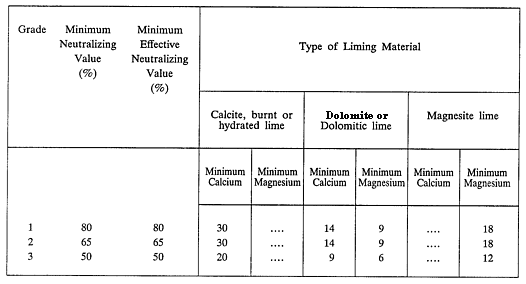
The grade of liming material is to be determined in accordance with the table set out in Schedule 2 .
(1) Gypsum described as naturally occurring gypsum is to contain not less than 16% sulphur.(2) Gypsum described as by-product gypsum is to contain not less than 4% sulphur and not more than 20% of the dry weight of the gypsum as moisture.
29. Standards of elemental sulphur
(1) In the case of elemental sulphur that is to be applied other than from the air, not less than 50% of the sulphur is to be capable of passing through a 0.25 mm sieve.(2) In the case of elemental sulphur that is to be applied from the air, not more than 30% of the sulphur is to be capable of passing through a 0.25 mm sieve.
(1) A fertilizer is not to contain more than 5 mg of mercury for each kilogram of fertilizer.(2) A fertilizer is not to contain more than the following amounts of cadmium:(a) [Regulation 30 Subregulation (2) amended by S.R. 1996, No. 104, Applied:24 Jul 1996] in the case of a phosphatic fertilizer, 350 mg for each kg of phosphorus;(b) in the case of a trace element fertilizer, 80 mg for each kg of fertilizer;(c) in any other type of fertilizer, 10 mg for each kg of fertilizer.(3) A fertilizer which is not a soil conditioner is not to contain more than 500 mg of lead for each kilogram of fertilizer.(4) A fertilizer which is a soil conditioner is not to contain more than 10 mg of lead for each kilogram of fertilizer.
PART 5 - Miscellaneous
(1) For the purposes of section 10 of the Act, a sample of a fertilizer is to be taken in the presence of the seller if possible.(2) Subject to subregulation (3) , a sample of a solid fertilizer is to be taken from a package of the fertilizer by inserting a tube into the centre of the package and removing a core of the fertilizer.(3) If a solid fertilizer is of a consistency which prevents a sample being taken in accordance with subregulation (2) –(a) the fertilizer is to be emptied from its package and broken and mixed to form a uniform mixture; and(b) the sample is to be taken from the uniform mixture.(4) In the absence of proof to the contrary, it is not a defence that a deficiency in a sample is due to the separation of constituents or ingredients during sampling or a lack of homogeneity in the fertilizer.
(1) If the number of packages of fertilizer to be sampled is greater than one, the samples taken from each package are to be combined to form a composite sample.(2) If the number of packages of fertilizer to be sampled is less than 5, a sample is to be taken from each package.(3) If the number of packages of fertilizer to be sampled is not less than 5, a sample is to be taken from one in every 10 packages but in any case from not less than 5 packages.(4) The total weight of a sample or composite sample of a particular fertilizer is not to be less than one kilogram.
(1) The inspector taking a sample is to mix the sample or composite sample thoroughly and divide the sample or composite sample into 3 equal parts.(2) The inspector taking the sample is to seal each part of the sample in a suitable package in the presence of the person apparently in charge of the premises or conveyance where the fertilizer has been sampled.(3) The inspector taking the sample is to mark each package with –(a) the date of sampling; and(b) the inspector's name; and(c) the address at which the sample was taken; and(d) the name of the person apparently in charge of the premises or conveyance or fertilizer; and(e) any details necessary to distinguish that part of the sample from parts of other fertilizers sampled at the premises or conveyance.(4) The inspector taking the sample is to –(a) provide one part to an analyst for analysis; and(b) retain one part; and(c) give one part to the person referred to in subregulation (2) .
Analysis of a sample is to be carried out by an analyst in accordance with procedures recommended by the National Association of Testing Authorities in Australia.
(1) The level of a characteristic of a fertilizer listed in column 1 of Schedule 3 as stated in a label, invoice or delivery docket is to be within the tolerance listed in column 2 of that Schedule.(2) In determining whether a characteristic of a sample of a fertilizer, of which phosphorus is a constituent, is within the tolerance –(a) an excess of water-soluble phosphorus may be set off against a deficiency of citrate-soluble phosphorus; and(b) an excess of citrate-soluble phosphorus may be set off against a deficiency of water-soluble phosphorus, if the percentage of citrate-soluble phosphorus is not more than 25% of the sum of the percentages of citrate-soluble phosphorus and water-soluble phosphorus.
The fees specified in Schedule 4 are fees prescribed for the purposes of the Act.
(1) An application for exemption under section 25 of the Act is to contain details of any action to be taken to make the fertilizer comply with the Act.(2) The Secretary may only grant an exemption if the applicant undertakes to notify the Secretary in writing, when required by the Secretary to do so, of the progress in making the fertilizer comply with the Act.(3) The Secretary may revoke an exemption if of the opinion that, in relation to making the fertilizer comply with the Act –(a) there has not been sufficient progress; or(b) the applicant has not given sufficient notification to the Secretary of the progress that has been made.(4) If the Secretary revokes an exemption, the Secretary, by notice in writing, is to notify the applicant of the revocation and the reasons for the revocation.
SCHEDULE 1 - Concentration of constituents
Column 1 | Column 2 | Constituent | Concentration | % | 1. | (a) Nitrogen | 0.5 | (b) Nitrogen as nitrate, ammonia, urea or any other form | 0.2 | 2. | (a) Phosphorus | 0.5 | (b) Phosphorus as water or citrate soluble | 0.2 | (c) Phosphorus as citrate insoluble | 0.2 | 3. | (a) Potassium | 0.5 | (b) Potassium as sulphate, chloride, nitrate or any other form | 0.2 | 4. | Calcium | 0.5 | 5. | Magnesium | 0.5 | 6. | Sulphur | 0.5 | 7. | Iron | 0.01 | 8. | Manganese | 0.01 | 9. | Copper | 0.005 | 10. | Zinc | 0.005 | 11. | Boron | 0.005 | 12. | Molybdenum | 0.001 | 13. | Cobalt | 0.001 | 14. | Chloride | 0.001 | 15. | Aluminium | 0.001 | 16. | Selenium | 0.001 |
SCHEDULE 2 - Grades of Lime
SCHEDULE 3 - Accuracy of label, invoice or delivery docket
COLUMN 1 | COLUMN 2 | Characteristic of fertilizer | Tolerance | 1. Effective neutralizing value | 10.0% | 2. Particle size | 10.0% | 3. A constituent which comprises 25% or more of the weight of the fertilizer | 2.0% | 4. A constituent which comprises 10% or more but less than 25% of the weight of the fertilizer | 4.0% | 5. A constituent which comprises less than 10% of the weight of the fertilizer | 10.0% |
SCHEDULE 4 - Fees
1. Making a complaint under section 14 of the Act | $25.00 | 2. Application for exemption under section 25 of the Act | $100.00 |
Displayed and numbered in accordance with the Rules Publication Act 1953.
Notified in the Gazette on 10 November 1993
These regulations are administered in the Department of Primary Industry and Fisheries.