

Trustee Companies Act 1953
An Act to consolidate and amend the law relating to trustee companies, and to repeal certain enactments
Be it enacted by His Excellency the Governor of Tasmania, by and with the advice and consent of the Legislative Council and House of Assembly, in Parliament assembled, as follows:
PART I - [Part I Heading inserted by No. 64 of 1985, s. 4 ]Preliminary
This Act may be cited as the Trustee Companies Act 1953 .
[Section 2 Amended by No. 64 of 1985, s. 27 and Sched. 1 ]The Acts that are specified in Schedule 1 are repealed.
[Section 3 Amended by No. 74 of 1978, s. 3 ][Section 3 Amended by No. 9 of 1982, s. 7 and Sched. 10 ](1) [Section 3 Subsection (1) substituted by No. 64 of 1985, s. 5 ][Section 3 Amended by No. 20 of 1990, s. 12 ][Section 3 Subsection (1) amended by No. 20 of 1995, s. 5 and Sched. 3 ][Section 3 Subsection (1) amended by No. 62 of 1996, s. 3 and Sched. 1 ]In this Act, unless the contrary intention appears –administrator means administrator pursuant to letters of administration;control includes control as a result of, or by means of, trusts, agreements, related corporations, arrangements, understandings, and practices, whether or not having legal or equitable force, and whether or not based on legal or equitable rights;the Court means the Supreme Court;financial institution means –(a) [Section 3 Subsection (1) amended by No. 74 of 1999, Sched. 2, Applied:01 Jan 2000] an authorised deposit-taking institution;(b) an insurance company;(c) a financial corporation to which the Financial Corporations Act 1974 of the Commonwealth applies;(d) the trustees or managers of a superannuation fund established by a law of the Commonwealth or of a State or Territory; or(e) a corporation that is prescribed as a financial institution for the purposes of this Act;[Section 3 Subsection (1) amended by No. 22 of 2000, s. 4, Applied:16 Jun 2000] GST has the meaning given to that term by the A New Tax System (Goods and Services Tax) Act 1999 of the Commonwealth;insurance company means a corporation that is registered under the Life Insurance Act 1945 of the Commonwealth;letters of administration means letters of administration with or without a will annexed;Public Trustee means The Public Trustee continued under the Public Trustee Act 1930 ;[Section 3 Subsection (1) amended by No. 22 of 2000, s. 4, Applied:16 Jun 2000][Section 3 Subsection (1) amended by No. 22 of 2000, s. 4, Applied:16 Jun 2000] regulations means regulations made and in force under this Act;related corporation means a corporation that is, by virtue of section 7 (5) of the Companies (Tasmania) Code , deemed to be related to another corporation;secretary, in relation to a trustee company, includes an acting secretary, manager, or acting manager of the trustee company;subordinated loan means a loan that is unsecured and the terms of which are evidenced by an instrument in writing that expressly provides that the rights of the lender are subordinated to all other creditors of the borrower;trust estate includes all real and personal property of whatever kind committed to the administration or management of a trustee company;trustee company means a company that is specified in Schedule 2 , and includes any company, association, society, or body of persons that is declared, pursuant to section 4 , to be a trustee company for the purposes of this Act;will includes codicil.(1A) [Section 3 Subsection (1A) omitted by No. 20 of 1990, s. 12 ]. . . . . . . .(1B) [Section 3 Subsection (1B) omitted by No. 20 of 1990, s. 12 ]. . . . . . . .(2) [Section 3 Subsection (2) amended by No. 36 of 1958, s. 4 and Sched. 4 ]The powers and functions of the Court under this Act shall, for the purposes of the Supreme Court Civil Procedure Act 1932 , be deemed to be part of the jurisdiction of the Court that is subject to that Act.
4. Declaration of companies, &c., to be trustee companies
(1) [Section 4 Subsection (1) amended by No. 64 of 1985, s. 27 and Sched. 1 ]Subject to this section, the Governor may, by proclamation, declare any company, association, society, or body of persons (whether incorporated or unincorporated) that is specified in the proclamation to be a trustee company for the purposes of this Act, and may, by the same or a subsequent proclamation, amend Schedule 2 by adding thereto the name of that company, association, society, or body of persons.(2) [Section 4 Subsection (2) amended by No. 20 of 1990, s. 13 ]The Governor shall not make a proclamation under subsection (1) in respect of any company, association, society, or body of persons except upon an address from both Houses of Parliament praying that the company, association, society, or body of persons be declared to be a trustee company for the purposes of this Act.(3) Any company, association, society, or body of persons that desires to be declared to be a trustee company for the purposes of this Act, shall cause to be presented to either of the Houses of Parliament, in accordance with the standing orders of that House, a petition praying that the necessary action be taken to have it declared to be a trustee company for the purposes of this Act.(4) When a petition under this section has been received by the House to which it is presented, the petition shall be referred to a select committee of that House, to be appointed by motion upon notice, and the select committee shall require proof of the statements and particulars contained in the petition.(5) If a select committee to which a petition under this section is referred recommends that the prayer of the petition be granted, the select committee shall cause an address to the Governor to be drafted and submitted for the approval of the 2 Houses.(6) [Section 4 Subsection (6) amended by No. 64 of 1985, s. 27 and Sched. 1 ]An address to the Governor under this section may be in accordance with Form 1 in Schedule 3 .(7) [Section 4 Subsection (7) amended by No. 55 of 1965, s. 5 ]Before a petition under this section is presented to either House of Parliament, the company, association, society, or body of persons proposing to present the petition –(a) shall cause notice of its intention to present the petition to be published, in accordance with the requirements of the standing orders of that House, as if the petition were a private Bill within the meaning of those standing orders;(b) shall cause to be paid to the credit of the Consolidated Fund the sum of $200 and a certificate of that payment to be lodged with the clerk of that House; and(c) shall cause to be given to the clerk of the relevant House, before the petition is presented to the House, a written guarantee that the company, association, society, or body of persons will be responsible to the Treasurer for all the expenses incurred by the select committee to which the petition is referred, over and above the sum paid under paragraph (b) .(8) Subject to this section, the provisions of the standing orders of the House of Parliament to which a petition under this section is presented, so far as they are applicable and with the necessary adaptations, apply to and in respect of the presentation and receipt of the petition and the proceedings thereon (including the proceedings of the select committee) in all respects as if the petition were a private Bill.(9) [Section 4 Subsection (9) substituted by No. 20 of 1990, s. 13 ]The Governor may, by proclamation, declare a company, association, society or body of persons (in this subsection referred to as "the company") to be a trustee company for the purposes of this Act if –and may, by the same or a subsequent proclamation, amend Schedule 2 accordingly.(a) the name of the company has, with the prior consent in writing of the Minister, been lawfully altered and the company is, under its former name, a trustee company for the purposes of this Act; or(b) the company is the result of the lawful amalgamation, with the prior consent in writing of the Minister, of 2 or more companies, associations, societies or bodies of persons each of which was, immediately before the amalgamation, a trustee company for the purposes of this Act –(10) [Section 4 Subsection (10) added by No. 20 of 1990, s. 13 ] Subsections (2) to (8) do not apply to the making of a proclamation under subsection (9) .
PART II - [Part II Heading inserted by No. 64 of 1985, s. 6 ]Trustee Companies
Division 1 - [Part II, Division 1 Heading inserted by No. 64 of 1985, s. 6 ]Administration of estates
5. Power of trustee company to act as executor
Where a trustee company has been (whether before or after the commencement of this Act) expressly, or according to the tenor, appointed as executor under the will of a testator, the company may act as executor, or as executor according to the tenor, as the case may be, and may apply for and obtain probate accordingly.
6. Power of trustee company to act as administrator
Where a natural person may apply for and obtain letters of administration of the estate of a deceased person, a trustee company may, in like circumstances, apply for and obtain letters of administration and act as administrator.
7. Power of courts, &c., to appoint trustee company as trustee, receiver, &c.
(1) [Section 7 Subsection (1) amended by No. 63 of 1963, s. 2 and Sched. 2 ]Where a court, judge, or person has power to appoint –that court, judge, or person may appoint a trustee company to be a trustee, receiver, committee, or guardian, or an attorney or agent, as the case may be.(a) a trustee;(b) a receiver;(c) [Section 7 Subsection (1) amended by No. 33 of 1996, Sched. 1, Applied:01 Sep 1997] an administrator of a person's estate under the Guardianship and Administration Act 1995 ;(d) a guardian of an infant's estate; or(e) an attorney or agent –(2) Where a trustee company is so appointed as a trustee, receiver, or committee, the trustee company may act as a trustee, receiver, or committee, as the case may be, until removed from office and may perform and discharge all acts and duties pertaining to the office of trustee, receiver, or committee.(3) [Section 7 Subsection (3) amended by No. 55 of 1965, s. 5 ]Notwithstanding the provisions of section 31 , if the paid-up capital of a trustee company is not less than $20 000, the liability imposed by that section upon the capital and assets of the company shall be deemed to be sufficient security for the discharge of those duties in place of the bond required from a natural person who is appointed as a receiver or committee.
8. Power of person entitled to probate to authorize trustee company to obtain probate
[Section 8 Amended by No. 64 of 1985, s. 7 ]A person who is named expressly or by implication as the executor of the will of a deceased person and who would be entitled to obtain in Tasmania probate of the will without reserving leave to any other person to apply for probate may, instead of himself applying for probate, authorize a trustee company to apply to the Court for administration with the will annexed; and administration with the will annexed may be granted to the trustee company, upon its own application, when so authorized, unless the testator has, by his will, expressed his desire that the office of executor should not be delegated or that a trustee company should not act in the trusts of his will.
9. Power of person entitled to administration to authorize trustee company to obtain administration
[Section 9 Amended by No. 64 of 1985, s. 8 ]A person who is entitled to obtain letters of administration, whether general, special, or limited, of the estate of another person, may, instead of himself applying for administration, authorize a trustee company to apply for administration of that estate, and administration of that estate may be granted to the trustee company upon its own application when so authorized.
10. Power of trustee company to act jointly with other persons or to obtain probate with leave to other persons to come in and prove
(1) Subject to subsection (2) , a person who is named expressly or by implication as the executor of the will of a deceased person and who would be entitled to obtain probate of the will jointly with any other person may, notwithstanding any law or custom to the contrary, instead of himself applying for probate of the will, authorize a trustee company to apply to the Court for probate thereof, either alone with leave reserved for any person to come in and prove, or jointly with any other person who is entitled to apply for probate, in the same manner as if the company had been originally named in the will in the place of the person by whom the application is authorized.(2) The power conferred by this section shall not be exercised in the case of a will in which the testator has expressed his desire that the office of executor should not be delegated or that a trustee company should not act in the trusts of his will.
10A. Election to administer small estates without grant of probate, &c.
[Section 10A Substituted by No. 64 of 1985, s. 9 ](1) Where –(a) a person dies, or has died, domiciled or leaving property in Tasmania;(b) a trustee company is entitled, or authorized by another person entitled, to obtain probate of the will of the deceased person or letters of administration of the estate of that deceased person; and(c) it appears to that trustee company that the gross amount of that estate to be administered in Tasmania does not exceed $20 000 or, if another amount is prescribed by the regulations, that other amount –that trustee company may, instead of applying for probate or letters of administration, file in the office of the Registrar of the Court an election under its common seal to administer that estate specifying –(d) the name, residence, occupation, and marital status so far as may be known to the trustee company, of the deceased person at the date of his death;(e) the names and the age, if surviving, or the date of death, if deceased, of any issue of the deceased person;(f) the property forming the estate of the deceased person so far as it is then known to the trustee company; and(g) the date of death of the deceased person.(2) Where a trustee company believes that a deceased person referred to in subsection (1) has died testate, an election under that subsection shall state –(a) that, after due inquiries, the trustee company believes that the document annexed to the election is the testator's last will or an exemplification of that will, if probate of that will or other appropriate testamentary grant has been made outside Tasmania; and(b) that that will has been validly executed according to law –and shall specify with respect to each beneficiary of the will of the deceased person –(c) his relationship, if any, to that person; and(d) particulars of the property of the deceased person to which that beneficiary is entitled as such.(3) On the filing of an election under subsection (1) , the trustee company filing it shall be deemed to be administrator or executor, as the case may be, of the property of the deceased person in all respects as if letters of administration or probate had been granted to it by the Court.(4) A trustee company shall publish in the Gazette a notice that it has made an election under subsection (1) .(5) A notice published in the Gazette under subsection (4) is evidence that the trustee company is entitled to administer the estate to which the notice relates.(6) If a trustee company –file in the office of the Registrar of the Court a memorandum under its common seal stating that fact, and revoking its election, and apply for letters of administration or probate, as the case may require.(a) after filing an election under subsection (1) , finds that the gross value of the property to be administered in Tasmania exceeds $22 000 or, if another amount is prescribed by the regulations, that other amount, the trustee company shall, as soon as practicable after it becomes aware of that fact; or(b) at any time considers it desirable for any reason so to do, the trustee company may –(7) If, after filing an election under subsection (1) , a trustee company finds –the trustee company shall, as soon as practicable after it becomes aware of that fact, file in the office of the Registrar of the Court a memorandum under its common seal stating that fact and revoking the election.(a) that the deceased person who was supposed to have died intestate has died testate; or(b) that the document annexed to the election as the testator's last will has been superseded by a later will, or for any reason is of no testamentary validity or effect –(8) Where a trustee company files a memorandum under subsection (7) –(a) the election previously made by the trustee company is revoked;(b) the trustee company may file a fresh election under subsection (1) ; and(c) the provisions of this section apply to, and in relation to, the estate previously subject to the election as if no such previous election relating to that estate had been made under subsection (1) .(9) A copy of an election filed under subsection (1) and certified as a correct copy under the seal of the Court has the same legal effect as an exemplification of probate.
11. Power of Court to act on affidavit of secretary of trustee company
Where a trustee company is authorized by or under this Act to apply for probate or letters of administration, the Court, or, as the case may be, the officer to whom an application for probate or letters of administration is made by the trustee company, may receive and act upon an affidavit by the secretary of the trustee company in lieu of an affidavit required by the Court to be made by a person making application for probate or administration.
12. Liability of assets of trustee company sufficient security in lieu of administration bond
[Section 12 Amended by No. 55 of 1965, s. 5 ][Section 12 Amended by No. 62 of 1996, s. 3 and Sched. 1 ]Notwithstanding the provisions of section 31 , where a trustee company –the liability imposed by that section upon the capital and assets of the company shall be deemed, in the case of letters of administration for which application is made by the company, to be sufficient security in lieu of the bond required in the case of an application for letters of administration by a natural person.(a) possesses a paid-up capital of not less than $20 000; and(b) has invested not less than $15 000 of its paid-up capital –(i) in securities of the Commonwealth; or(ii) [Section 12 Amended by No. 74 of 1999, Sched. 2, Applied:01 Jan 2000] upon fixed deposit in an authorised deposit-taking institution carrying on business in this State in the name of the Treasurer in trust for the company but transferable only upon the joint consent of the Treasurer and the company or upon the order of the Court–
13. Power of trustee company to act under power of attorney
(1) A trustee company may act under a power of attorney by which the company is appointed attorney by a person, and all the powers conferred upon the company by a power of attorney may be exercised and carried into execution by the secretary, or by any 2 or more of the directors, of the company.(2) Where a trustee company is appointed attorney by a person, the capital of the company (whether paid or unpaid capital), and all other assets of the company, are liable for the due execution of the powers so conferred upon the company.(3) This section does not authorize a person to confer a power upon a trustee company that cannot legally be conferred upon a natural person.
14. Power to appoint trustee company as temporary executor, &c.
An executor or administrator, or a trustee, may appoint a trustee company to act as executor, administrator, or trustee in his stead, and if a trustee company is so appointed by deed filed in accordance with any law in force providing for the filing of powers of attorney –(a) the company may act within the scope of the authority conferred upon it as effectually as the executor, administrator, or trustee could have acted;(b) the company may exercise all discretionary and other powers that are delegated to it by the principal as fully and effectually as the principal could have exercised them; and(c) after the filing of the power of attorney, every act of the company that is within the scope of the authority so conferred shall, in favour of any person who deals with the company in good faith and without notice of the death of the principal or of his revocation of the authority, be valid and effectual notwithstanding the revocation by, or death of, the principal.
15. Power of executors, &c., to appoint trustee company to discharge their duties
(1) [Section 15 Subsection (1) amended by No. 33 of 1996, Sched. 1, Applied:01 Sep 1997] [Section 15 Subsection (1) amended by No. 63 of 1963, s. 2 and Sched. 2 ]The executor or administrator, acting under any probate or letters of administration, or a receiver, or the administrator of the estate of a person under the Guardianship and Administration Act 1995 , may, with the consent of the Court, appoint a trustee company to perform and discharge all the acts and duties of the executor, administrator, receiver, or committee, and the trustee company may perform and discharge all those acts and duties accordingly, and the executor, administrator, receiver, or committee so appointing the company is released from liability in respect of all acts done, or omitted to be done, by the company acting under that appointment.(2) Notice of an intended application for the consent of the Court under this section shall be advertised once in one daily newspaper published in Hobart, and in one daily newspaper published elsewhere in this State, at least 14 days before the making of the application, and the Court may require a person who resides in this State and is entitled to the immediate receipt of any of the income or corpus of the estate in respect of which the application is made to be served with notice thereof.(3) No consent shall be given by the Court under this section in the case of a will in which the testator has expressed his desire that the trusts thereof should not be delegated or that a trustee company should not act therein.
15A. Power of trustee company to undertake other services
[Section 15A Inserted by No. 25 of 1970, s. 3 ](1) [Section 15A Subsection (1) substituted by No. 64 of 1985, s. 10 ]A trustee company may manage properties and businesses held or carried on in trust by it or by other trustees, if the trustee company directly controls that management.(2) For such services a trustee company may charge such fees as it may determine.(3) Such fees may be based on the work done and the responsibility involved.(4) Where the Court is of opinion that a fee charged under this section is excessive it may review and reduce that fee and, for that purpose, make such orders as it thinks fit.
15B. Loans from estates to related corporations prohibited
[Section 15B Inserted by No. 64 of 1985, s. 11 ][Section 15B Amended by No. 43 of 1991, s. 5 and Sched. 1 ]A trustee company shall not make a deposit or loan to a related corporation from an estate administered or managed by the trustee company under this Act.Penalty: Fine not exceeding 200 penalty units.
15C. No trust estate to be liable under guarantee from trustee company unless given on behalf of that estate
[Section 15C Inserted by No. 64 of 1985, s. 11 ](1) A trust estate administered or managed by a trustee company is not liable for the payment of money under a guarantee from the trustee company otherwise than under a guarantee lawfully given by the trustee company on behalf of that trust estate.(2) Subsection (1) does not authorize a trustee company to give a guarantee on behalf of a trust estate to a related corporation.
16. Power of trustee company to act as if it were a natural person
Where a trustee company is appointed to any office or position pursuant to any of the provisions of this Act, the trustee company may do and perform all acts and duties and exercise all powers and discretions that appertain to that office or position as fully and effectually as if the company were a natural person.
17. Power of secretary to attend on behalf of trustee company
(1) Where the personal attendance of an executor, administrator, trustee, receiver, or committee is required in a court or elsewhere, a trustee company shall be entitled to make the attendance in the person of the secretary of the company, and the personal duties of executor, administrator, trustee, receiver, or committee may be discharged, on behalf of a trustee company, by the secretary thereof.(2) Where a trustee company obtains probate or letters of administration to be granted to the company, and where a trustee company is appointed and acts as a trustee, receiver, or committee, the secretary of the trustee company and the directors of the trustee company are individually and collectively in their own persons responsible to the Court, and, in their own persons, are liable, by process of attachment, commitment for contempt, or by other process, to all courts having jurisdiction in that behalf, for the proper discharge of their duties and for obedience to the rules, orders, and decrees of those courts, in the same manner and to the same extent as if the secretary and the directors had personally obtained probate or letters of administration or had acted as executor, administrator, trustee, receiver, or committee.(3) Nothing in subsection (2) limits or affects the operation of section 31 .
17A. Borrowing by trustee companies
[Section 17A Inserted by No. 64 of 1985, s. 12 ](1) [Section 17A Subsection (1) amended by No. 43 of 1991, s. 5 and Sched. 1 ]Notwithstanding anything in the Companies (Tasmania) Code or in the memorandum or articles of association of a trustee company, a trustee company shall not –(a) accept a deposit of money with, or a loan of money to, the trustee company from any trust estate committed to its administration or management; or(b) except as provided by this Act, accept a deposit of money with, or a loan of money to, the trustee company on its own behalf from any other person.Penalty: Fine not exceeding 200 penalty units.(2) Notwithstanding subsection (1) , a trustee company may borrow money if –(a) the money is –(i) borrowed from a financial institution; or(ii) a subordinated loan from a related corporation (if any) of the trustee company; and(b) after 30th June 1985, the total of all borrowings by the trustee company from financial institutions and the liability (other than any contingent liability) of the trustee company under a bill of exchange or promissory note and the amount of the proposed loan together do not exceed the total amount of the net tangible assets of the trustee company specified in the last declaration made by the trustee company under section 18H .(3) Nothing in this section affects or limits the investment of money of an estate by a trustee company in a Common Fund established under this Act.
18. Commission chargeable by trustee company
(1) [Section 18 Subsection (1) amended by No. 55 of 1965, s. 3 and Sched. 1 ][Section 18 Subsection (1) amended by No. 25 of 1970, s. 4 ][Section 18 Subsection (1) amended by No. 91 of 1975, s. 3 ][Section 18 Subsection (1) amended by No. 64 of 1985, s. 13 ]A trustee company may charge and receive, in addition to any money properly expended by it and chargeable against an estate that is placed under the administration or control of the company, commission at such rate as may be fixed by the board of directors or other governing body of the company but not exceeding, in any case –(a) 5 per cent of the capital value of any estate that is committed to the administration or management of the company as executor, administrator, trustee, receiver, or committee, or as an attorney acting under a power of attorney (being the capital value thereof as at the time of the realization of the estate); and(b) 5 per cent of the income received by the company as executor, administrator, trustee, receiver, or committee, or as an attorney acting under a power of attorney.(2) The provisions of subsection (1) apply to perpetual trusts created, and to estates committed to the administration or management of a trustee company, whether before or after the commencement of this Act.(3) A trustee company, if it is expressly authorized so to do by a will or other instrument whereby the administration or management of an estate is committed to the company, but not otherwise, may charge and receive commission at such rate as may be specified in the will or other instrument, notwithstanding that the rate so specified is in excess of the rate prescribed in subsection (1) .(4) [Section 18 Subsection (4) amended by No. 64 of 1985, s. 13 ]The rate of commission that is fixed by the board of directors or other governing body of a trustee company pursuant to this section shall be notified by the secretary of the company in the Gazette and in not less than one newspaper published or circulating in the city or town in which the principal office of the company in this State is situated.(4A) [Section 18 Subsection (4A) inserted by No. 25 of 1970, s. 4 ]Where the commission chargeable in respect of an estate under subsection (1) would not otherwise exceed $100 or such other amount as may be prescribed, a trustee company may charge that sum as and for its commission.(4B) [Section 18 Subsection (4B) inserted by No. 22 of 2000, s. 5, Applied:16 Jun 2000] In addition to the commission payable under this section, a trustee company may charge against the estate any GST payable in respect of its services for that estate.(5) Where the Court is of opinion that the commission charged by a trustee company against an estate is excessive it may review and reduce the commission so charged, and, for that purpose, may make such orders as it thinks fit.
18A. Management charge in respect of charitable trusts, &c.
[Section 18A Inserted by No. 91 of 1975, s. 4 ](1) [Section 18A Subsection (1) amended by No. 22 of 2000, s. 6, Applied:16 Jun 2000] Where a trustee company administers a charitable trust or a trust of indefinite duration for a purpose other than the individual benefit of persons having an interest under the trust, the company is entitled to receive and charge, for each complete period of 5 years for which it so administers the trust and in addition to any GST payable in respect of its services, a sum of such amount as the board of directors or other governing body of the trustee company may determine, not exceeding 0·25 per cent of the value of the property the subject of the trust as determined at the end of that period of 5 years.(2) For the purpose of recovering in whole or in part any sum that a trustee company may receive and charge under subsection (1) in respect of a trust, it may, as the board of directors or other governing body of the company determines, appropriate to its use any of the property the subject of the trust or the proceeds of the realization thereof or any of the income received by the company as trustee of the trust.(3) A trustee company is not entitled, under this section, to receive or charge any sum in respect of its administration of a trust earlier than the commencement of the period of 5 years ending on the commencement of the Trustee Companies Act 1975 , but, subject to the foregoing provisions of this subsection, a trustee company is entitled to receive and charge such a sum in respect of its administration of a trust during a period, notwithstanding that that period commenced before the commencement of this section.(4) The rights of a trustee company under this section in respect of its administration of a trust are in addition to, and not in derogation of, its right to charge, receive, or recover, under this Act or otherwise, any commission or other sums in respect of its administration of the trust.(5) Where the Court is of opinion that any sums charged by a trustee company under this section in respect of its administration of a trust are excessive, it may review and reduce the sums so charged, and, for that purpose, may make such orders as it thinks fit.
Division 2 - General powers[Part II, Div. 2 Inserted by No. 64 of 1985, s. 14 ]
18B. Power of trustee company to undertake other services
[Section 18B Inserted by No. 64 of 1985, s. 14 ]A trustee company may –(a) prepare and lodge taxation returns;(b) if so authorized by a will or other instrument creating a trust or by an instrument signed by all persons beneficially entitled to the income of any property or business, manage that property or carry on that business in accordance with any terms or conditions specified in that will or other instrument; and(c) hold property as a custodian trustee unless it is prohibited from doing so by virtue of, or it is inconsistent with, any trusts to which that property is subject.
18C. Power of trustee companies to establish Common Funds
[Section 18C Inserted by No. 64 of 1985, s. 14 ](1) A trustee company may establish and keep in its books one or more funds to be called a "Common Fund" and, if more than one, with an appropriate distinguishing number.(2) The money comprised in a Common Fund established in the books of a trustee company shall be invested in –(a) investments for a term of not less than a year secured by first mortgages of land in Tasmania; or(b) investments authorized by the Trustee Act 1898 .(3) A trustee company may invest any money in its hands either –(a) on the separate account of the trust estate to which the money belongs; or(b) if the money is not directed to be invested in a manner specified in the trust deed, will, or other instrument governing the money and investment in a Common Fund is not inconsistent with that instrument, as part of a Common Fund established and kept in the books of the company if that investment is limited to a class or classes of investments in which that money might lawfully be invested on its separate account.(4) Investments made from money forming part of a Common Fund shall not be made on account of, or belong to, any particular trust estate, but the trustee company shall cause to be kept in the records of the company an account showing at all times the current amount at credit in a Common Fund on account of each trust estate.(5) A trustee company may sell investments belonging to a Common Fund and may withdraw any of the money belonging to a Common Fund for any purpose of, or relating to, the exercise and discharge of its powers, authorities, duties, and functions.(6) A trustee company may, at any time, withdraw from a Common Fund an amount at credit in a Common Fund on the account of a trust estate and invest that amount on the separate account of that trust estate.(7) An amount so withdrawn from a Common Fund shall, on and from the date of the withdrawal, cease to have any claim for interest or otherwise from a Common Fund.(8) Any profits or losses on realization of any investment in a Common Fund shall be credited or debited, as the case requires, to the Common Fund and be received or borne proportionately by the several amounts invested in the Common Fund at the time of that realization.(9) As soon as practicable after the first day of each month, a trustee company shall determine the value of the investment as on that day in each Common Fund established by it under this section.(10) In respect of securities listed on a stock exchange, the quotations published by that stock exchange are evidence of value or, if there are no such quotations on a particular day, the valuation of the chairman or secretary of the relevant stock exchange is evidence of that value.(11) Investments in, or withdrawals from, a Common Fund shall, during any month, be effected on the basis of the value determined under subsection (9) as on the first day of that month.(12) A trustee company shall pay or allocate the income arising from a Common Fund proportionately to or among the trust estates entitled to the income arising from the capital sums invested in the Common Fund according to the several sums so invested and the periods for which they remain so invested.(13) [Section 18C Subsection (13) amended by No. 74 of 1993, s. 4 ]In addition to the commission, fees, and remuneration which it is entitled to receive under section 18 or 18A , a trustee company is entitled to charge and receive from, or out of, any income received by a Common Fund –(a) a fee (according to the value of the work done and the services rendered) calculated at a rate not exceeding 1% a year on the capital sums invested in the Common Fund during the period in respect of which the income is received or allocated for the establishment, keeping (including the keeping of books of accounts), conduct and management of the Common Fund; and(b) [Section 18C Subsection (13) amended by No. 22 of 2000, s. 7, Applied:16 Jun 2000] an amount equal to money properly expended by the trustee company in relation to the keeping, conduct and management of the Common Fund; and(c) [Section 18C Subsection (13) amended by No. 22 of 2000, s. 7, Applied:16 Jun 2000] an amount equal to any GST payable in respect of its services arising from the Common Fund.
18D. Power of trustee company to mix funds for investment
[Section 18D Inserted by No. 64 of 1985, s. 14 ](1) Where a trustee company holds for investment –(a) money belonging to an estate of which it is the sole trustee; and(b) money belonging to another estate of which it is sole trustee or to a person for whom it acts as agent to invest that money –the trustee company may –(c) invest all that money as one fund in one or several securities;(d) distribute the income arising from those securities, after deducting all proper charges, rateably among the several estates and persons from which or from whom the money so invested was derived; and(e) in the same manner debit any loss arising from the investment rateably to those several estates and persons.(2) Nothing in this section authorizes a trustee company to invest money belonging to any estate or person in a security in which that money could not lawfully be invested apart from this section.
18E. Investment by trustee company of its own funds
[Section 18E Inserted by No. 64 of 1985, s. 14 ]A trustee company may invest its own funds –and may, if prudent to do so having regard to the nature of its assets and liabilities, exercise any rights accruing to it by virtue of those investments, shares, or securities.(a) in the acquisition of land in Tasmania;(b) on the security of a first mortgage of land in Tasmania;(c) in other investments authorized by the Trustee Act 1898 ;(d) in shares in a body corporate incorporated or registered under the law of a State or Territory that has entered into an agreement with the trustee company to provide goods or services to the trustee company; or(e) in public securities listed by a stock exchange that is approved under Part III of the Securities Industry (Tasmania) Code –
Division 3 - Duties of trustee companies[Part II, Div. 3 Inserted by No. 64 of 1985, s. 14 ]
18F. Duty of trustee company not to acquire shares in itself
[Section 18F Inserted by No. 64 of 1985, s. 14 ](1) [Section 18F Subsection (1) amended by No. 43 of 1991, s. 5 and Sched. 1 ]Notwithstanding anything contained in the trust deed, will, or other instrument under which a trust is created, a trustee company shall not at any time after the administration or management of a trust estate is committed to it, acquire any shares in itself on behalf of that trust estate.Penalty: Fine not exceeding 200 penalty units.(2) Subsection (1) does not prevent a trustee company from retaining on behalf of a trust estate any shares in itself or from exercising any rights of that trust estate with respect to those shares if those shares were included in the trust estate when its administration or management was committed to the trustee company.
18G. Trustee company to give information to Attorney-General where directed
[Section 18G Inserted by No. 64 of 1985, s. 14 ](1) [Section 18G Subsection (1) amended by No. 43 of 1991, s. 5 and Sched. 1 ]A trustee company shall furnish to the Attorney-General within such time as he specifies such information in writing or statements in respect of its business as he may direct.Penalty: Fine not exceeding 100 penalty units.(2) The Attorney-General may, where it appears to him to be necessary or advisable, cause to be carried out –(a) a review of the operations of a trustee company;(b) an audit of the records and accounts of a trustee company (including the records and accounts of any of the trust estates managed or administered by the trustee company); or(c) both the review and the audit.(3) For the purposes of a review or audit under subsection (2) , a trustee company shall –(a) deliver to a person authorized by the Attorney-General to that effect a list of all books kept by it;(b) produce to that person at all reasonable times when required the records kept by it and all accounts, vouchers, papers, and other documents of the trustee company; and(c) afford that person all necessary information and all other necessary facilities for enabling him to carry out that review or audit.(4) Unless the Attorney-General otherwise directs, the costs of an audit or review under this section shall be borne by the trustee company and may be recovered by the Attorney-General in a court of competent jurisdiction as a debt due to the Crown.
18H. Declaration by trustee company
[Section 18H Inserted by No. 64 of 1985, s. 14 ](1) [Section 18H Subsection (1) substituted by No. 20 of 1990, s. 14 ]A trustee company shall from time to time, in accordance with the regulations, cause to be prepared, a declaration as to the state of affairs of the company.(2) [Section 18H Subsection (2) amended by No. 20 of 1990, s. 14 ]A copy of each declaration made under subsection (1) –(a) shall, within 7 days after the making of the declaration, be lodged with the Commissioner for Corporate Affairs;(b) shall, within 7 days after the making of the declaration, be exhibited in a conspicuous place in the registered office of the trustee company concerned and in every branch office or place where the business of the trustee company is carried on; and(c) shall remain so exhibited until the next occasion on which the trustee company causes a statutory declaration to be exhibited under this section.(3) [Section 18H Subsection (3) amended by No. 43 of 1991, s. 5 and Sched. 1 ]If a trustee company fails to comply with a provision of this section –(a) the trustee company is guilty of an offence and is liable on summary conviction to a penalty of a fine not exceeding 3 penalty units for each day during which the default continues; and(b) each director and manager of the trustee company who knowingly and wilfully authorizes or permits the default is guilty of an offence and is liable on summary conviction to a penalty of a fine not exceeding 1 penalty unit for each day during which the default continues.(4) A declaration under this section in relation to a trustee company is not required to show –(a) liabilities incurred by the trustee company while acting as trustee or in a representative capacity to the extent to which the trustee company has a valid and subsisting right of indemnity out of any assets in respect of those liabilities and those assets are sufficient to satisfy that right of indemnity; and(b) assets, consisting of the value, if any, of any such right of indemnity arising from the incurring of those liabilities.(5) [Section 18H Subsection (5) omitted by No. 20 of 1990, s. 14 ]. . . . . . . .
18I. Declaration as to assets and liabilities of trustee company
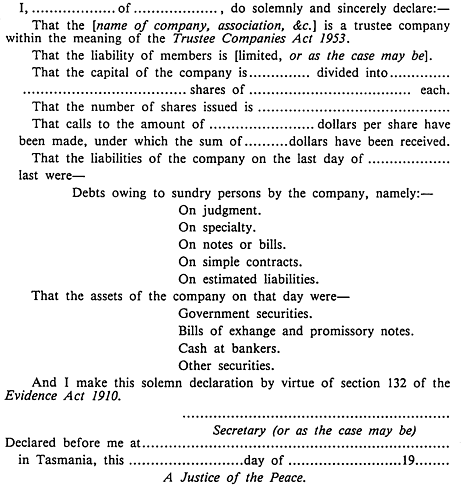
[Section 18I Inserted by No. 64 of 1985, s. 14 ](1) A trustee company –(a) shall, within one month after the half-yearly balancing date of the company in each year during which the company carries on business in Tasmania, make a statutory declaration, in accordance with Form 2 in Schedule 3 , as to the assets and liabilities of the company;(b) shall cause a copy of the declaration –(i) to be published in the Gazette as soon as practicable after the making of the declaration;(ii) to be exhibited in a conspicuous position in the principal office of the company in Tasmania and in every branch office or other place in Tasmania where the business, or any part of the business, of the company is carried on; and(iii) to be furnished free of charge to a creditor of the company who makes application for a copy of the declaration; and(c) shall, on being requested by a shareholder or member of the company so to do, deliver or send by post a copy of the declaration to that shareholder or member free of charge.(2) [Section 18I Subsection (2) amended by No. 43 of 1991, s. 5 and Sched. 1 ]If a trustee company fails to comply with a provision of subsection (1) –(a) the trustee company is guilty of an offence and is liable on summary conviction to a penalty of a fine not exceeding 3 penalty units for each day during which the default continues; and(b) each director and manager of the trustee company who knowingly and wilfully authorizes or permits the default is guilty of an offence and is liable on summary conviction to a penalty of a fine not exceeding 1 penalty unit for each day during which the default continues.
18J. Employment of solicitor by trustee company
[Section 18J Inserted by No. 64 of 1985, s. 14 ](1) Where –the trustee company shall employ that solicitor accordingly.(a) by a will, deed, or other instrument in writing, a trustee company or any other trustee appointed by the will, deed, or instrument, is directed to employ a solicitor who is named in that will, deed, or instrument to conduct the legal or professional business associated with the administration or management of the trust estate referred to in that will, deed, or instrument; or(b) a trustee company, before the administration or management of any trust or estate is transferred or committed to it, agrees with a solicitor to employ him in or about the legal or professional business associated with the administration or management of that trust estate –(2) Where a solicitor is employed by a trustee company pursuant to subsection (1) , he shall be deemed to be the solicitor of the company in the legal or professional business to which that subsection relates, and shall not be removed except by order of the Court under subsection (3) .(3) Upon the application of a trustee company or of a person who has an interest in a trust estate to which subsection (1) relates, the Court, on such cause being shown as the Court may think sufficient, may order the removal of a solicitor who is employed by the company pursuant to that subsection, and may appoint another solicitor to act as the solicitor of the company for the purposes of that trust estate.
Division 4 - [Part II, Div. 4 Heading inserted by No. 64 of 1985, s. 15 ]Control of trustee companies
19. Power of Court to remove trustee company from office
[Section 19 Subsection (1) amended by No. 64 of 1985, s. 16 ](1) [Section 19 Subsection (1) amended by No. 25 of 1970, s. 5 ]Where a trustee company is appointed executor, administrator, trustee, receiver, committee, agent, or attorney under power, the company is, in addition to the liabilities and restrictions imposed by this Act, subject in all respects to the same control and liability to removal as if it were a natural person.(2) A person who claims relief against a trustee company for or in respect of an act done or assumed to be done, or in respect of an act omitted to be done, by the company, or by any of its directors or officers, under any of the powers conferred by this Act, may take appropriate proceedings in the Court or in any other court of competent jurisdiction and the court in which the proceedings are taken may make and enforce such orders as that court may think just in the circumstances.
(1) [Section 20 Subsection (1) inserted by No. 64 of 1985, s. 17 ][Section 20 Subsection (1) amended by No. 20 of 1990, s. 15 ]In subsection (2) , prescribed person, in relation to a deceased person, means –(a) the widow or widower of that deceased person;(b) a trustee, beneficiary, executor, legatee, administrator, next of kin, or creditor of that deceased person; or(c) a person who is entitled to make an application under the Testator's Family Maintenance Act 1912 for provision out of the estate of that deceased person.(2) [Section 20 Subsection (2), formerly (1) renumbered by No. 64 of 1985, s. 17 ]If a prescribed person who is entitled to or interested in an estate that has come into the possession or under the control of a trustee company is unable, upon application to the secretary of the company, to obtain a sufficient account of the property and assets of which the estate consists, and of the disposal and expenditure thereof or thereout, he may apply to the Court, after notice to the company, for an account.(3) [Section 20 Subsection (3), formerly (2) renumbered by No. 64 of 1985, s. 17 ]If, on an application being made under this section, the Court is of the opinion that no sufficient account has been rendered by the company, the Court shall order such account to be rendered by the company as the Court thinks just, or, if the Court thinks that no sufficient case has been established to require the company to furnish an account, it may dismiss the application.
The Court may, on an application under section 20 , order, in addition to or in substitution for any account to be rendered by a trustee company, that a person to be named in the order shall examine the books and accounts of the company with reference to the estate as to which the order is made, and, in that case, the company shall deliver to the person named in the order a list of the books and accounts kept by the company with reference to that estate, and shall produce to that person at all reasonable times when required by him those books and accounts, and all vouchers, papers, and other documents of the company with reference to that estate, and shall furnish him with all necessary information and all other necessary facilities for enabling him to make the examination.
22. Power of Court to restrain voluntary winding up of trustee company
[Section 23 Repealed by No. 64 of 1985, s. 18 ]. . . . . . . . [Section 24 Repealed by No. 64 of 1985, s. 18 ]. . . . . . . . [Section 25 Repealed by No. 64 of 1985, s. 18 ]. . . . . . . .(1) So long as any estate in respect of which a trustee company is executor, administrator, or trustee remains in whole or in part unadministered, no person shall take any steps or proceedings to wind up the company voluntarily, except with the sanction of the Court.(2) A person who is interested in an estate to which subsection (1) relates, or who may have a claim in respect thereof, may apply to the Court, in a summary way, to restrain any director or shareholder from disposing of a share that the director or shareholder may hold in the company, or to restrain the winding up voluntarily of the company, and the Court has power to make such order in the matter as the circumstances of each case appear to the Court to require.
Division 5 - [Part II, Div. 5 Heading inserted by No. 64 of 1985, s. 19 ]Distribution of deceased estates
26. Power of trustee company to distribute assets without regard to claims of creditors after notice and failure of creditors to take proceedings
(1) When a trustee company refuses to recognize, in whole or in part, the claim of a person who claims to be a creditor against the estate of a deceased person, the trustee company may give notice in writing of its refusal to the person so claiming.(2) If the person so claiming does not, within 3 months after the receipt of a notice under subsection (1) , institute proceedings to enforce his claim the trustee company may distribute the assets of the deceased person without regard to the claim or to so much thereof as the trustee company has, by that notice, refused to recognize, and thereupon the right of that person to recover the amount of the claim, or the part thereof that the trustee company has refused to recognize, is barred.(3) A notice under this section may be served by registered post on the person for whom it is intended.
27. Power of trustee company to distribute estate where possible claimants have not claimed
(1) Subject to this section, when –the trustee company, after advertising as required under this section, may, without being under any liability to the said person or to any other person claiming through him or as his issue or one of his issue, distribute the estate as if the said person had predeceased the deceased person without issue.(a) a trustee company –(i) has been granted probate of the will, or letters of administration of the estate, of a deceased person; and(ii) has been informed of the existence at any time of a person (in this section referred to as "the said person") who, if he had survived the deceased person, would have been entitled to a legacy under the will, or to the whole or a share of the estate, of the deceased person; and(b) neither the said person nor any other person claiming through him or as his issue or one of his issue has made a claim in respect of that legacy, estate, or share within 3 years after the grant of probate or letters of administration –(2) The trustee company shall, before making a distribution pursuant to this section, make a report to a judge setting out the material facts relating to the matter and obtain a direction from the judge as to the form and number of the advertisements to be inserted and the places in which they are to be published and fixing a time after the insertion of the last of those advertisements at the expiration of which the distribution may be made.(3) Nothing in this section prejudices the right of a person to follow any assets into the hands of the person or persons who have received them.
28. Power of trustee company to make advances to beneficiaries
Where an estate is committed to the administration or management of a trustee company, the company may, pending the realization of the estate, make out of its own funds such advances, upon and subject to such conditions, as it thinks fit, to a person who is entitled, whether absolutely or contingently, to the whole or a share of the estate.
PART III - [Part III Heading inserted by No. 64 of 1985, s. 20 ]Miscellaneous and Supplemental
Division 1 - Restrictions on classes of business[Part III, Div. I Heading inserted by No. 64 of 1985, s. 20 ]
29. Restrictions on classes of business that may be undertaken by trustee company
[Section 29 Subsection (1) amended by No. 66 of 1962, s. 3 and Sched. 1 ][Section 29 Subsection (1) amended by No. 9 of 1982, s. 7 and Sched. 10 ][Section 29 Subsection (2) amended by No. 25 of 1970, s. 7 ](1) [Section 29 Subsection (1) amended by No. 29 of 1959, s. 2 and Sched. 1 ]Notwithstanding anything contained in the Companies (Tasmania) Code or in the memorandum or articles of association of a trustee company, no trustee company shall engage in, carry on, or be concerned in, any business, trade, venture, or undertaking except –(a) such as is expressly authorized by this Act;(b) general agency business;(c) the deposit of its own funds with a person carrying on the business of a bank of deposit; and(d) the investment of those funds in any manner in which trustees are authorized to invest trust funds by section 5 of the Trustee Act 1898 .(2) [Section 29 Subsection (2) amended by No. 7 of 1960, s. 2 ]This section does not preclude a trustee company from –(a) guaranteeing the safety of the principal, and the regular payment of the interest, of trust funds committed to its administration or management;(b) giving or entering into a bond or guarantee for the purpose of enabling a person to obtain administration of the estate of a deceased person where that estate is placed under the administration or management of the company by the administrator;(c) advancing out of its own funds such sums as may be necessary for the purpose of paying any tax or duty payable under a law of the Commonwealth or of a State in respect of the estate of a deceased person where it is necessary or convenient so to do in order to facilitate the granting to the company of probate or letters of administration or the resealing in this State of probate of the will or letters of administration of the estate of a deceased person granted elsewhere than in this State;(d) expending or advancing out of its own funds such sums as the company may determine for the purpose of purchasing homes for employees of the company or of making loans to employees of the company to assist them to purchase homes for themselves;(e) purchasing or leasing such premises, or purchasing or hiring such equipment, as may be necessary or convenient for the proper exercise or performance of any powers or duties conferred or imposed on the company by or under this Act;(f) investing out of its funds such sums as the Governor may approve in or towards the improvement or erection of buildings on land owned by the company, and granting leases of any such buildings or land; or(g) acquiring and holding as beneficial owner shares in a company the principal business of which is that of a registrar of shares or debentures or a secretary of companies.(3) [Section 29 Subsection (3) amended by No. 17 of 1996, Applied:25 May 1998] [Section 29 Subsection (3) amended by No. 55 of 1965, s. 5 ]Any director, member, or officer of a trustee company who is concerned in, or is a party to, a wilful contravention of the provisions of this section is liable to a fine not exceeding 2 penalty units, or to imprisonment for 3 months, or to both.
Division 2 - [Part III, Div. 2 Heading inserted by No. 64 of 1985, s. 21 ]Accounts and audit
30. Trustee company to keep separate accounts of each estate
An account of the money paid or received, and of investments made and money advanced, by a trustee company on account of each estate of which the company has the administration or management in pursuance of this Act, shall be kept by the company separate and distinct from that of any other estate of which it has the administration or management.
31. Assets of trustee company liable for proper discharge of company's duties
Subject to this Act, all the capital (whether paid capital or unpaid capital) of a trustee company and all the assets of a trustee company are liable for the proper discharge of any duties that are undertaken by the company pursuant to this Act.
32. Trustee company to pay certain unclaimed moneys to Public Trustee
[Section 32 Inserted by No. 36 of 1958, s. 4 and Sched. 4 ](1) Except in a case to which subsection (2) applies, a trustee company shall pay to the Public Trustee all moneys that form part of an estate of which the company is the executor, administrator, or trustee and that remain unclaimed by the person who is entitled thereto for a period of 5 years after the time when they become payable to that person.(2) Subsection (1) does not apply in a case where payment of any moneys is restrained by order of a court of competent jurisdiction.(3) [Section 32 Subsection (3) amended by No. 20 of 1995, s. 5 and Sched. 3 ]Subject to this section, moneys that are paid to the Public Trustee pursuant to this section shall be held by the Public Trustee as belonging to the particular estate in respect of which they are paid and on behalf of the person entitled thereto.(4) [Section 32 Subsection (4) amended by No. 20 of 1995, s. 5 and Sched. 3 ]Moneys that are paid to the Public Trustee pursuant to this section form part of the common fund, within the meaning of the Public Trustee Act 1930 , and may be invested by the Public Trustee in the manner provided by that Act.(5) Except as provided by section 37 , the Public Trustee shall not pay over to a person any moneys, or any part thereof, or any interest arising therefrom, unless an order is made by the Court directing the payment thereof and specifying the amount to be paid and the name, description, and addition of the person to whom it is to be paid.(6) The Public Trustee shall credit to the particular estates quarterly on the usual quarterly days interest upon all moneys that are paid to the Public Trustee pursuant to this section, and the interest so credited shall be added to those moneys and accumulated by way of compound interest.(7) For the purposes of this section and of sections 35 and 37 , moneys that were paid to the Public Trustee by a trustee company before the commencement of this section pursuant to the Unclaimed Trust Moneys Act 1921 shall be deemed to have been so paid pursuant to this section.
33. Transfer of securities to Public Trustee
[Section 33 Inserted by No. 36 of 1958, s. 4 and Sched. 4 ](1) Where any moneys that are required by section 32 to be paid to the Public Trustee are invested in securities, those moneys shall, notwithstanding the investment, be deemed to be, and to remain, moneys within the meaning and for the purposes of that section, and a reference in that section to the payment of any moneys shall, in the case of moneys that are so invested, be construed as a reference to the transfer of the securities for the time being representing those moneys.(2) [Section 33 Subsection (2) amended by No. 20 of 1995, s. 5 and Sched. 3 ]In the case of moneys that are so invested, in lieu of the provisions of section 32 relating to interest the interest that is actually received by the Public Trustee in respect of any security shall, until the maturity thereof, be credited to the particular estate in respect of which the security is held, and, on the maturity of the security, shall be added to the capital moneys arising therefrom and thenceforth those capital moneys and the interest thereon shall form part of the common fund, within the meaning of the Public Trustee Act 1930 .
34. Notice of unclaimed trust moneys
[Section 34 Inserted by No. 36 of 1958, s. 4 and Sched. 4 ][Section 34 Subsection (3) amended by No. 67 of 1994, s. 3 and Sched. 1 ](1) A trustee company shall, at the end of each period of 6 months after the commencement of this section, deliver to the Public Trustee a statement of all unclaimed moneys that, during the preceding 6 months, were in its hands.(2) [Section 34 Subsection (2) amended by No. 20 of 1995, s. 5 and Sched. 3 ]A statement under this section shall distinguish the several estates in respect of which the moneys have been received by the trustee company and set forth the dates and amounts of the several payments thereof to the Public Trustee under section 32 , and, if those moneys or any part thereof have not been paid to the Public Trustee, shall also set forth the reason for the non-payment thereof.(3) [Section 34 Subsection (3) amended by No. 55 of 1965, s. 5 ]In default of compliance with the provisions of this section in respect of a trustee company, the company, and the secretary of the company, and every member of the board of directors or other governing body of the company, are jointly and severally liable to a fine not exceeding 0·1 penalty unit for each day during which the default continues.
34A. Powers and duties of auditors of trustee companies
[Section 34A Inserted by No. 64 of 1985, s. 22 ](1) In this section, unless the contrary intention appears –accounts means profit and loss accounts and balance-sheets and includes –but does not include any such accounts, balance-sheets, statements, reports, or notes relating to the conduct of a business or the management of property solely as an agent;(a) statements, reports, and notes, other than auditors' reports or directors' reports, attached to, or intended to be read with, any of those profit and loss accounts or balance-sheets; and(b) accounts relating to trust estates as mentioned in subsection (2) –appointed auditor, in relation to a trustee company, means a registered company auditor who is appointed auditor of the trustee company under Division 3 of Part VI of the Companies (Tasmania) Code ;group accounts, in relation to a trustee company that is a holding company, means –and includes the accounts relating to the trust estates, if any, of each subsidiary of the trustee company;(a) a set of consolidated accounts for the group of companies of that holding company;(b) 2 or more sets of consolidated accounts together covering that group;(c) separate accounts for each corporation in that group; or(d) a combination of one or more sets of consolidated accounts and one or more separate accounts together covering that group –group of companies, in relation to a trustee company that is a holding company, means the holding company and the corporations that are subsidiaries of the holding company;holding company means a trustee company that is a holding company of a corporation.(2) An appointed auditor shall, in addition to his duties under the Companies (Tasmania) Code , audit the accounts of the trustee company relating to its trust estates and, if it is a holding company for which group accounts are required, shall also audit the accounts relating to the trust estates, if any, of each of its subsidiaries.(3) An appointed auditor shall, in a report required to be furnished under section 285 of the Companies (Tasmania) Code , state –(a) whether the accounts of the relevant trustee company considered as a whole and, if the company is a holding company for which group accounts are required, the group accounts are, in his opinion, properly drawn up –(i) so as to give a true and fair view of the matters required by section 269 of the Companies (Tasmania) Code to be dealt with in the accounts and, if there are group accounts, in the group accounts; and(ii) in accordance with the provisions of the Companies (Tasmania) Code ;(b) whether the accounting records and other records relating to the trust estates required by the Companies (Tasmania) Code to be kept by the trustee company and, if it is a holding company, by the subsidiaries other than those of which he has not acted as auditor, have been, in his opinion, properly kept in accordance with the provisions of the Companies (Tasmania) Code ;(c) any defect or irregularity in the accounts or group accounts and any matter not set out in the accounts or group accounts without regard to which a true and fair view of the matters dealt with by the accounts or group accounts would not be obtained; and(d) if he is not satisfied as to any matter referred to in paragraph (a) or (b) , his reasons for not being so satisfied.(4) For the purposes of this section –(a) an appointed auditor may exercise the same powers, and is subject to the same duties, as are specified in Division 3 of Part VI of the Companies (Tasmania) Code ; and(b) the provisions of the Companies (Tasmania) Code apply to, and in relation to, an audit required by this section and the keeping of the accounting records of a trustee company relating to its trust estates.
Division 3 - [Part III, Div. 3 Heading inserted by No. 64 of 1985, s. 23 ]Powers of Supreme Court
35. Power of judge to make orders as to the payment, &c., of moneys and securities
[Section 35 Inserted by No. 36 of 1958, s. 4 and Sched. 4 ](1) [Section 35 Subsection (1) amended by No. 117 of 1973, s. 2 ]Upon application made to a judge in chambers by summons by a person who claims to be entitled thereto, the judge may make such order as he thinks just with respect to –(a) the payment or delivery of any moneys or securities that have been paid or transferred to the Public Trustee pursuant to section 32 or paid to the Treasurer by the Public Trustee pursuant to section 37 , and with respect to the accumulations of interest thereon; and(b) the administration generally of the trusts relating to any moneys or securities so paid or transferred.(2) [Section 35 Subsection (2) amended by No. 117 of 1973, s. 2 ]A summons under this section shall be served on such persons, and in such manner, as the judge may direct.(3) [Section 35 Subsection (3) amended by No. 117 of 1973, s. 2 ]Upon the hearing of an application under this section, the judge may make such order as to costs as he thinks fit and, if the Public Trustee or the Treasurer appears on the hearing of the application, the Public Trustee or the Treasurer shall be entitled to such costs, if any, against the person making the application or out of the moneys to which the application relates as the judge may direct.(4) [Section 35 Subsection (4) amended by No. 117 of 1973, s. 2 ]If, on the hearing of an application under this section, it appears to the judge that any moneys or securities cannot safely be paid or delivered without the institution of an action, the judge may, instead of making an order under this section, direct that an action be instituted.(5) [Section 35 Subsection (5) amended by No. 117 of 1973, s. 2 ]The judge may order the payment of interest on any moneys that are paid to the Treasurer by the Public Trustee pursuant to section 37 from the time they are so paid until they are made the subject of an order under this section, at such rate as the judge may determine.(6) [Section 35 Subsection (6) amended by No. 117 of 1973, s. 2 ]No application shall be made under this section in respect of –(a) any moneys or securities paid or delivered to the Public Trustee pursuant to section 32 after the expiration of 6 years after the moneys or securities have been so paid or transferred;(b) any moneys paid to the Treasurer by the Public Trustee pursuant to section 37 after the expiration of 10 years after they are so paid; or(c) any moneys paid to the Treasurer by a trustee company under any Act specified in the Schedule to the Unclaimed Trust Moneys Act 1921 , after the expiration of 16 years after they are so paid.(7) [Section 35 Subsection (7) amended by No. 117 of 1973, s. 2 ]An order made under this section has the same effect, and is enforceable and is subject to appeal, in all respects as if it were an order made in an action.
36. Power of Court to make order for account on application of Public Trustee
[Section 36 Inserted by No. 36 of 1958, s. 4 and Sched. 4 ](1) [Section 36 Subsection (1) amended by No. 20 of 1995, s. 5 and Sched. 3 ]If the Public Trustee is unable, on application to the secretary of a trustee company, to obtain a sufficient account of the property and assets of an estate that is, or in its opinion ought to have been, included in a statement under section 34 , the Public Trustee may, after notice to the company, apply to the Court for an account.(2) If, on the hearing of an application under this section, the Court is of the opinion that no sufficient account has been rendered by the trustee company, the Court may order an account to be rendered within such time as it may fix in that behalf, or if the Court is of the opinion that a sufficient case to require the company to furnish an account has not been made out it may dismiss the application.(3) On the hearing of an application under this section the Court may make such order as to costs as it thinks fit.
Division 4 - [Part III, Div. 4 Heading inserted by No. 64 of 1985, s. 24 ]Miscellaneous
37. Public Trustee to pay moneys to the Treasurer after 6 years
[Section 37 Inserted by No. 36 of 1958, s. 4 and Sched. 4 ]At the expiration of the period of 6 years after any moneys or securities are paid or transferred to the Public Trustee pursuant to section 32 , the Public Trustee shall, unless an order as to the payment or delivery thereof has been made under section 35 , pay the moneys or, as the case may be, the moneys arising from the securities, to the Treasurer to the credit of the Consolidated Fund.
38. Saving of rights of other companies, &c.
[Section 38, formerly 32 Renumbered by No. 36 of 1958, s. 4 and Sched. 4 ]Nothing in this Act confers on a trustee company any locus standi to oppose the granting of similar powers to those conferred by this Act upon that company to any other company, association, society, or body of persons, or to corporations generally, or to claim or seek compensation in consequence of those powers being conferred upon any other company, association, society, or body of persons, or upon corporations generally.
39. Trustee company to insure for uncalled liability
[Section 39 Substituted by No. 20 of 1990, s. 16 ][Section 39 Substituted by No. 65 of 1997, s. 3, Applied:12 Dec 1997](1) A trustee company must arrange with an insurer and keep in force at all times a policy of indemnity insurance for an amount which is not less than the total nominal value of the shares of the company issued on the commencement of this section.(2) A trustee company must, at the request of the Attorney-General, produce evidence of any insurance required to be arranged and kept in force under this section.
39AA. Special provisions relating to the holding, controlling and disposal, &c., of shares in trustee companies
[Section 39AA Inserted by No. 74 of 1978, s. 4 ][Section 39AA Amended by No. 64 of 1985, s. 27 and Sched. 1 ][Section 39AA Amended by No. 20 of 1990, s. 17 ][Section 39AA Amended by No. 74 of 1993, s. 5 ]The provisions of Schedule 5 apply to and in relation to –(a) the holding or controlling, or the holding and controlling, of shares in a trustee company;(b) persons holding or controlling, or holding and controlling, any of those shares; and(c) the issue, allocation, transfer, transmission and disposal of any of those shares in the circumstances specified in that Schedule.
39A. Certificate of trustee company to be accepted as evidence
[Section 39A Inserted by No. 117 of 1973, s. 3 ](1) A certificate sealed by a trustee company certifying the nature of the company's appointment in relation to any estate, and any facts on the happening of which that appointment was made, shall be accepted by all courts, officers, and other persons as sufficient evidence of all the facts therein set forth, without the production of any other proof whatever.(2) The certificate referred to in subsection (1) shall be sufficient for the purpose of registering the trustee company as proprietor of any shares, stock, or property in any company, body, or association, or of any estate or interest in any land under the Land Titles Act 1980 , or of bringing any land under that Act, and may be registered against that land as in the case of probate or letters of administration, and shall have the same force and effect.(3) The certificate referred to in subsection (1) shall be equivalent, for registration purposes under any Act, to probate or letters of administration, and it shall not be necessary to register the probate or letters of administration.
40. Saving of incorporation and powers of trustee companies
[Section 40, formerly 35 Renumbered by No. 36 of 1958, s. 4 and Sched. 4 ]Except so far as is expressly provided in this Act –(a) a trustee company remains subject to the same liabilities, restrictions, and penalties, and continues to enjoy the same powers and privileges, as it is subject to and enjoys under its incorporation; and(b) nothing in this Act affects the incorporation of a trustee company.
[Section 40AA Inserted by No. 17 of 1996, s. 30 ]The provisions of section 18H as in force immediately before the commencement of the Justice Legislation (Miscellaneous Amendments) Act 1990 continue to have effect, notwithstanding the amendments made by section 14 of that Act , until regulations making provision for the purposes of section 18H (1) as substituted by that Act take effect, and any such regulations may make provision with respect to the respective application of the first-mentioned provisions and the provisions of the regulations.
[Section 40A Substituted by No. 20 of 1990, s. 18 ](1) The Governor may make regulations for the purposes of this Act.(2) The regulations may make provision for or with respect to the establishment and operation of a Common Fund under section 18C .
[Section 41 Substituted by No. 64 of 1985, s. 25 ](1) The judges, or a majority of them, may make Rules of Court for the purposes of this Act, except for, or with respect to, any matter on which regulations may be made under section 40A .(2) Without limiting the generality of subsection 1 , the Rules of Court may make provision for, or with respect to, conferring a right to inspect and copy any information specified in an election filed in the office of the Registrar of the Court under section 10A (1) .
SCHEDULE 1 - Acts Repealed[Schedule 1 Amended by No. 64 of 1985, s. 27 and Sched. 1 ]
Year and number (if any) of Act | Short title of Act | 51 Vict. (Private) | "The Perpetual Trustees Company Act" | 51 Vict. (Private) | "The Tasmanian Trustees Association Act" | 3 Geo. V (Private) | National Executors Company Act 1912 | 19 Geo. V No. 65 | Equity Trustees Company Act 1928 | No. 15 of 1948 | Tasmanian Woolgrowers' Trustees and Executor Company Act 1948 |
SCHEDULE 2 - Trustee Companies[Schedule 2 Substituted by No. 20 of 1990, s. 19 ]
Perpetual Trustees Tasmania Limited. | Tasmanian Trustees Limited. |
SCHEDULE 3 - Forms[Schedule 3 Amended by No. 64 of 1985, s. 27 and Sched. 1 ][Schedule 3 Form 1A repealed by No. 20 of 1990, s. 20 ][Schedule 3 Form 2 amended by No. 55 of 1965, s. 5 ][Schedule 3 Form 2 amended by No. 64 of 1985, s. 26 ]
Sections 4 , 23
Form 1 - Form of Address to the Governor under Section 4

Form 2 - Declaration Under Section 18I as to Assets and Liabilities of a Trustee Company

SCHEDULE 4[Schedule 4 Repealed by No. 20 of 1990, s. 21 ]
SCHEDULE 5 - [Schedule 5 Heading amended by No. 20 of 1990, s. 22 ]Special Provisions Relating to the Holding, Controlling and Disposal of Shares in Trustee Companies[Schedule 5 Inserted by No. 74 of 1978, s. 6 ][Schedule 5 Amended by No. 64 of 1985, s. 27 and Sched. 1 ][Schedule 5 Amended by No. 20 of 1990, s. 22 ][Schedule 5 Amended by No. 74 of 1993, s. 6 ]
1. . . . . . . . .
2. Limitation on number of shares, &c., to be held or controlled, &c., in trustee companies(1) [Schedule 5 Amended by No. 100 of 1999, s. 12, Applied:15 Dec 1999] A person shall not, at any time, have an interest in more than 10 per cent of the issued shares in a trustee company.(1A) For the purposes of subparagraph (1) , a person shall be taken to have an interest in a share if that person –(a) holds, controls or holds and controls that share in that person's own right; or(b) has a beneficial interest in that share.(1B) A person who contravenes subparagraph (1) is guilty of an offence and liable on summary conviction –(a) in the case of a person other than a body corporate, to a fine not exceeding 50 penalty units or imprisonment for a term not exceeding 2 years, or both; or(b) in the case of a person that is a body corporate, to a fine not exceeding 100 penalty units.(2) For the purposes of this paragraph, where related corporations hold or control, or hold and control, shares in a trustee company, those related corporations shall be deemed to be one person.(3) For the purposes of this paragraph, a person shall be deemed (but not to the exclusion of any other person) to control shares if he is in a position to exercise, wholly or partially and whether directly or indirectly, control of the voting rights attached to those shares.(4) For the purposes of this paragraph, a person shall not be deemed to control shares merely by reason of –(a) his appointment as proxy or attorney for the holder of those shares; or(b) his appointment or his acting as a personal representative of the estate of a deceased person –a trustee company.(i) who was a shareholder in; or(ii) who had a beneficial interest in, or who controlled shares in –(5) An issue, allotment, transfer or transmission of shares that causes a contravention of subparagraph (1) is not invalid by reason only of that contravention.
3. Control of issue, allotment and transmission of shares(1) An issue, allotment or transmission of shares in a trustee company must not be made or registered if it would cause a contravention of paragraph 2 (1) .(2) Before issuing or allotting shares, or registering the transmission of shares, in a trustee company, the directors of the company may require the person to whom the shares are to be issued, allotted or transmitted to provide a statutory declaration or other evidence sufficient to show that the issue, allotment or transmission will not cause a contravention of paragraph 2 (1) .
3A. Restraints on voting, &c., rights of certain shares(1) If a person holds, controls or holds and controls shares in a trustee company in contravention of paragraph 2 , the directors of the company, by notice in writing provided to the person, may require the person not to exercise any voting or other rights that are attached to those shares and are specified in the notice.(2) A person who fails to comply with a requirement given under subparagraph (1) is guilty of an offence and liable on summary conviction –(a) in the case of a person other than a body corporate, to a fine not exceeding 50 penalty units or imprisonment for a term not exceeding 2 years, or both; or(b) in the case of a person that is a body corporate, to a fine not exceeding 100 penalty units.
4. Power of directors of trustee companies to require declarations regarding holding and control of shares, &c.(1) The directors of a trustee company may at any time and from time to time, by written notice, require a person who is registered as the holder of shares in the company to declare –(a) whether he holds all the shares registered in his name as a beneficial owner thereof and, if not, how otherwise and on whose behalf;(b) whether any other person controls all or any of the shares registered in his name and, if so, the number of those shares and the name of the person who controls them; and(c) whether he is the beneficial owner of, or has a beneficial interest in, any shares other than the shares registered in his name and, if so, the number of those shares and the name of the registered holder.(2) A person to whom a notice has been given by a trustee company pursuant to subparagraph (1) shall, within 14 days after the service of the notice on him, furnish the company with a statutory declaration or other sufficient evidence setting forth –(a) whether or not he holds all the shares registered in his name as beneficial owner thereof, particulars of the person or persons who is or are the beneficial owner or owners thereof, the address of each such person, and the number of shares beneficially owned by each such person; and(b) whether any other person controls all or any of the shares registered in his name and in respect of any shares so controlled, particulars of the person or persons who controls or control those shares, the address of each such person, and the number of shares controlled by each such person.
5. Forced sale of shares by trustee companies(1) If a person –the directors of the company may procure the disposal of those shares in the manner provided in this paragraph.(a) holds or controls, or holds and controls, shares in a trustee company in contravention of any of the provisions of paragraph 2 ; or(b) fails to furnish a statutory declaration or other evidence as required under paragraph 4 in respect of any shares registered in his name –(2) . . . . . . . .(3) The directors of a trustee company may cause the company to give written notice to a person to whom –at the time of the giving of the notice shall be disposed of within such period, being not less than 6 months, asis specified in the notice.(a) subparagraph (1) (a) applies, requiring that the number of shares specified in the notice and held or controlled, or held and controlled, by that person in contravention of paragraph 2 ; or(b) subparagraph (1) (b) applies, requiring that the number of shares specified in the notice and held or controlled, or held and controlled, by that person –(4) A resolution of the board of directors for the time being of a trustee company made at a duly constituted board meeting is conclusive evidence of the existence of the circumstances set out in subparagraph (1) (a) , subparagraph (1) (b) , or subparagraph (2) .(5) If a person to whom a notice is given under subparagraph (3) by a trustee company does not comply with the requirements of the notice within the time specified in it, the directors of the company –(a) may cause the company to give written notice to that person requiring him to deliver to the company the share certificate or certificates to the shares held or controlled, or held and controlled, by that person;(b) may –(i) in the case of a person who is given a notice under subparagraph (3) (a) , cause the number of shares held or controlled, or held and controlled, by that person that are specified in the notice to be sold;(ii) in the case of a person who is given a notice under subparagraph (3) (b) , cause the number of shares held or controlled, or held and controlled, by that person that are specified in the notice, or any lesser number, to be sold; or(iii) in the case of a person who is given a notice under subparagraph (3) (b) , cause the number of shares held or controlled, or held and controlled, by that person that are specified in the notice to be sold;(c) may, if the person is the holder of the shares, appoint a person as the holder of the shares on his behalf to execute a transfer or transfers of the shares and to receive and give a good discharge for the purchase money; and(d) may register the transfer or transfers consequent on the sale, notwithstanding that the share certificate or certificates to those shares may not have been delivered to the company and may issue a new certificate to the transferee or transferees, in which event the previous certificate or certificates shall for all purposes be deemed to have been cancelled.(6) Where a notice is given under subparagraph (3) by a trustee company, the voting rights attached to the shares to which the notice relates –(a) are suspended for the period commencing on the date on which the notice is given and ending on the date on which the shares are sold in compliance with the notice; or(b) in a case where those shares are not so sold, are suspended for the period commencing on the date on which the notice is given and ending on the date on which the shares are sold, if the company causes them to be sold pursuant to subparagraph (5) .(7) The purchase money received under subparagraph (5) (b) for the sale of shares in a trustee company –(a) shall be held in trust by the company for the person who held or controlled, or held and controlled, those shares; or(b) shall be paid by the company to the registered holder of the shares.(8) A payment under subparagraph (7) by a trustee company is sufficient to extinguish the liability and obligation of the company in relation to the payment.(9) After the name of a transferee has been entered in the register of a trustee company in purported exercise of the powers conferred by this paragraph, the validity of the proceedings shall not be questioned by any person.
6. Requirements as to noticesA notice required by this Schedule to be given to a person –(a) shall be in writing signed by the manager or secretary of the trustee company by which it is given; and(b) shall be delivered to that person personally or sent by prepaid post addressed to him at his address appearing in the share register or in the transfer of shares submitted by him to the company.