

Animal (Brands and Movement) Regulations 2003
I, the Lieutenant-Governor in and over the State of Tasmania and its Dependencies in the Commonwealth of Australia, acting with the advice of the Executive Council, make the following regulations under the Animal (Brands and Movement) Act 1984 .
1 December 2003W. J. E. COX
Lieutenant-Governor
By His Excellency's Command,
BRYAN GREEN
Minister for Primary Industries, Water and Environment
PART 1 - PRELIMINARY
These regulations may be cited as the Animal (Brands and Movement) Regulations 2003 .
These regulations take effect on 1 January 2004.
(1) In these regulations, unless the contrary intention appears –Act means the Animal (Brands and Movement) Act 1984 ;[Regulation 3 Subregulation (1) amended by S.R. 2006, No. 148, Applied:27 Dec 2006] approved means approved by the Registrar;[Regulation 3 Subregulation (1) amended by S.R. 2006, No. 148, Applied:27 Dec 2006] establishment identification means a unique alphanumeric code issued by Meat & Livestock Australia Limited (ABN 39 081 678 364) and used to identify premises in reports to the NLIS database;[Regulation 3 Subregulation (1) amended by S.R. 2006, No. 148, Applied:27 Dec 2006] licensed meat premises means meat premises licensed under the Meat Hygiene Act 1985 ;[Regulation 3 Subregulation (1) amended by S.R. 2006, No. 148, Applied:27 Dec 2006] national vendor declaration number means the serial number printed on a national vendor declaration form issued by Meat & Livestock Australia Limited (ABN 39 081 678 364);[Regulation 3 Subregulation (1) amended by S.R. 2006, No. 148, Applied:27 Dec 2006] NLIS means the National Livestock Identification System;[Regulation 3 Subregulation (1) amended by S.R. 2006, No. 148, Applied:27 Dec 2006] NLIS database means the NLIS database maintained by Meat & Livestock Australia Limited (ABN 39 081 678 364);[Regulation 3 Subregulation (1) amended by S.R. 2006, No. 148, Applied:27 Dec 2006] NLIS number means either of the following unique numbers used to identify a bovine animal:(a) the number printed on the outside of the permanent identification device that is attached to or inserted in the animal;(b) the number encoded in the microchip contained within that device;[Regulation 3 Subregulation (1) amended by S.R. 2006, No. 148, Applied:27 Dec 2006] property identification code means a unique code issued by the Registrar to identify premises;[Regulation 3 Subregulation (1) amended by S.R. 2006, No. 148, Applied:27 Dec 2006] public scale operation means a public event to which cattle are delivered for assessment and possible sale to the holder of the event.(2) In these regulations, a reference to a form by number is a reference to the form so numbered in Schedule 1 .
PART 2 - BRANDS AND TAGS: REGISTRATION AND RELATED MATTERS
4. Form of Animal Brands and Tags Register
For the purposes of section 6(1) of the Act, the register is to be kept in either or both of the following forms:(a) print-outs produced by a computer;(b) documents produced otherwise than by a computer.
5. Cattle and sheep that do not have to be branded with registered earmarks
For the purposes of section 8(2) of the Act, the following classes of sheep and cattle are prescribed:(a) cattle that are registered by a breed society as stud cattle;(b) sheep of which the pedigree for not less than 3 generations is kept by, or is in the possession of, the person in charge of the sheep;(c) ram lambs that are –(i) no more than 12 months of age; and(ii) intended for live export to a country that requires any sheep exported to it not to be branded with an earmark.
(1) For the purposes of section 10(1)(c) of the Act –(a) the pig is to be branded with the registered body-tattoo in a clear and legible manner; and(b) the registered body-tattoo is to be located on the pig's shoulder.(2) For the purposes of sections 10(1)(d) , 11(4) , 11(5) and 21(4) of the Act, the body-tattoo or registered body-tattoo is to consist of no more than 3 letters of the English alphabet –(a) each of which is in an approved typeface and at least 20 millimetres, but no more than 35 millimetres, high; and(b) in an approved combination if there is more than one letter.
7. Nature and dimensions of earmarks for cattle and sheep
For the purposes of sections 11(1) and 18(1)(a) of the Act, the earmark or registered earmark is to be of the nature and dimensions specified in Schedule 2 .
8. Nature and dimensions of body-brands for cattle and sheep
(1) For the purposes of sections 11(2) , 11(3) , 11(5) , 19(1) and 21(4) of the Act, the body-brand or registered body-brand is to –(a) consist, for a cattle body-brand, of a chemical brand, fire-brand, or freeze-brand; and(b) consist, for a sheep body-brand, of a chemical brand or wool-brand; and(c) contain no more than 3 approved letters of the English alphabet or, in the case of a body-brand that is taken to be registered pursuant to clause 5(a) of Schedule 1 to the Act, comply with regulation 55(1) of the former Stock Regulations 1983; and(d) be constructed so that no part of the face of the brand is more than 7 millimetres wide; and(e) be at least 50 millimetres, but no more than 110 millimetres, high (unless it consists of a letter within a sign, in which case the body-brand may be up to 130 millimetres high).(2) In this regulation –chemical brand means a brand that is imposed on the skin of cattle or sheep by means of a depilatory substance on the skin;fire-brand means a body-brand that is intended to be burnt by a branding iron on the hides of cattle;freeze-brand means a body-brand that is imposed on the skin of cattle by means of an implement that has been subjected to a freezing process;wool-brand means a body-brand that is intended to be imprinted or imposed on the wool of sheep.
(1) For the purposes of sections 11(2) and 22(1)(b) of the Act, the tag or registered tag is to be –(a) a tag, of an approved nature and dimensions, consisting of no more than 3 letters of the English alphabet in an approved combination (if any), typeface and size; or(b) an approved electronic or electromagnetic tag; or(c) an approved implant or other device of approved dimensions.(2) For the purposes of section 22(1)(a) of the Act, the registered tag is to be attached somewhere other than the ear that is required to be branded with a registered earmark under section 18(1) of the Act.(3) If the tag or registered tag is of a kind referred to in subregulation (1)(a) , the particulars of identification are, for the purposes of section 22(1)(c) of the Act, the letter or letters mentioned in that subregulation.
10. Brands and tags: application for registration or transfer of rights
(1) An application under section 11 or 13(1) of the Act is to be in an approved form.(2) A single application form may be used for the purposes of section 11 of the Act by the owner of any cattle or sheep who wants to obtain –(a) registration of an earmark for the purposes of section 8(1) of the Act; and(b) registration under section 9(1) or (3) of the Act.(3) A single application form may be used for the purposes of section 13(1) of the Act if the proprietor referred to in that section wishes to transfer more than one right.
11. Fee for application for registration
For the purposes of sections 11(6)(e) and 13(3)(d) of the Act, the prescribed fee is 27 fee units.
(1) For the purposes of section 12(1) of the Act, the certificate of registration is to be in accordance with Form 1.(2) For the purposes of section 13(5)(b) of the Act, the certificate of transfer is to be in accordance with Form 2.
13. Applications for issue of duplicate certificates
For the purposes of section 12(4) of the Act, the application for the duplicate certificate is to be –(a) in accordance with and contain the information required by Form 3; and(b) accompanied by a fee of 9 fee units; and(c) delivered or sent by post to the Registrar.
14. Preparations for branding sheep
For the purposes of section 20 of the Act, the prescribed preparation is a branding fluid containing a scourable dye.
A person must not, for the purpose of branding the ears of any cattle, use, or cause or permit to be used, a branding instrument that is so constructed that it removes more than one third of the ear.Penalty: Fine not exceeding 5 penalty units.
16. Branding for identification to prevent spread of disease, &c.
(1) The Chief Veterinary Officer may require the person in charge of any cattle, sheep or pigs to have them branded in the prescribed manner for the purposes of identification if the Chief Veterinary Officer considers the branding necessary or desirable for the purposes of –(a) preventing the spread of a disease; or(b) facilitating the diagnosis of a disease; or(c) facilitating the conduct of an experiment or investigation.(2) The requirement may be made orally or in writing.(3) A person who is required under subregulation (1) to have any cattle, sheep or pigs branded must comply with that requirement –(a) within such time as the Chief Veterinary Officer specifies when making the requirement; or(b) if no time is specified by the Chief Veterinary Officer, as soon as practicable after the requirement is made.Penalty: Fine not exceeding 5 penalty units.(4) For the purposes of subregulation (1) , the prescribed manner is –(a) if subregulation (1)(a) or (b) applies, a manner directed orally, or in writing, by an inspector; or(b) if subregulation (1)(c) applies, an approved manner.(5) A person who is required under subregulation (1) to have any cattle, sheep or pigs branded must, in complying with that requirement, ensure that the design of the brand applied to the cattle, sheep or pigs is –(a) in accordance with –(i) the appropriate design (if any) specified in Schedule 3 ; or(ii) the appropriate design registered in the name of the Department; and(b) if the requirement pertains to cattle or sheep, located on the left ear of a female and on the right ear of a male.Penalty: Fine not exceeding 5 penalty units.
17. Tagging cattle for slaughter or sale
(1) Subject to subregulations (2) and (3) , a person in charge of any cattle must ensure that they are each tagged for identification with the prescribed tag before they are taken, from the property where they are normally kept, to be –(a) slaughtered at licensed meat premises, within the meaning of the Meat Hygiene Act 1985 ; or(b) sold at a public saleyard.Penalty: Fine not exceeding 5 penalty units.(2) A person who purchases cattle that have been tagged in accordance with subregulation (1) is not required to retag those cattle under that subregulation for a sale or slaughter that occurs within 7 days of the date of that purchase.(3) If a person who is required to tag cattle under subregulation (1) –he or she may have the cattle tagged with an emergency tag.(a) is genuinely unable to tag the cattle with the prescribed tag; and(b) has, through providing the Registrar with an approved declaration for the purposes of this subregulation, obtained an emergency tag –(4) The Registrar is to keep a record of all emergency tags obtained for the purposes of subregulation (3) .(5) In this regulation –emergency tag means a tag that contains –(a) an approved code that identifies the saleyard or district the cattle are from; and(b) a serial number;prescribed tag means a prescribed tag under Schedule 4 .
18. Return of untagged or improperly tagged cattle
(1) If a person fails to comply with regulation 17(1) in respect of any cattle, an inspector may direct the person to return the cattle to the property where they were last normally kept, either immediately or within such time as the inspector specifies.(2) The direction may be given orally or in writing.(3) A person must comply with a direction under subregulation (1) .Penalty: Fine not exceeding 5 penalty units.
PART 2A - PROCUREMENT OF PERMANENT IDENTIFICATION DEVICES AND TAGS
18A. Procurement of permanent identification devices
[Regulation 18A Inserted by S.R. 2006, No. 4, Applied:15 Feb 2006] A person who is required to attach or insert a permanent identification device to or in any animal pursuant to a notice under section 22FA of the Act must procure that permanent identification device through an ordering system approved by the Registrar.Penalty: Fine not exceeding 5 penalty units.
18B. Procurement of prescribed tags
[Regulation 18B Inserted by S.R. 2006, No. 4, Applied:15 Feb 2006] A person who is required to attach a prescribed tag to cattle pursuant to regulation 17(1) must procure that prescribed tag through an ordering system approved by the Registrar.Penalty: Fine not exceeding 5 penalty units.
PART 3 - MOVEMENT OF PIGS
For the purposes of section 27 of the Act, a waybill is to be in an approved form.
20. Exemptions from making out waybills
The Chief Veterinary Officer may exempt a person from having to comply with section 27(1) or (2) of the Act, either generally or in a particular case, if the Chief Veterinary Officer is satisfied on reasonable grounds that it is not necessary for the person to so comply.
PART 3A - VENDOR DECLARATIONS AND MOVEMENT RECORDS
20A. Vendor declarations for cattle, pigs, sheep and goats
[Regulation 20A Inserted by S.R. 2006, No. 148, Applied:27 Dec 2006](1) This regulation applies if –(a) there is a sale or other change of ownership of stock; and(b) the change of ownership involves a movement of stock from premises (in this regulation referred to as the "place of origin") to other premises (in this regulation referred to as the "destination"); and(c) the destination has a different property identification code to the place of origin.(2) The person in charge of the stock at the place of origin must, within 7 days after the day on which the stock are moved from the place of origin, provide a vendor declaration to –(a) if the destination is premises at which the stock are to be publicly auctioned, the person selling the stock on behalf of the vendor; or(b) in the case of any other destination, the person in charge of the stock at the destination.Penalty: Fine not exceeding 5 penalty units.(3) A person who provides a vendor declaration under subregulation (2) must –(a) state, in the vendor declaration, that the information provided in it is true and correct; and(b) must sign the vendor declaration.Penalty: Fine not exceeding 5 penalty units.(4) The person in charge of the stock at the place of origin must keep a copy of the vendor declaration in good condition for at least –(a) if the vendor declaration is in respect of sheep or goats, 7 years; and(b) in the case of any other vendor declaration, 2 years.Penalty: Fine not exceeding 3 penalty units.(5) A person who is provided with a vendor declaration under subregulation (2) must keep the vendor declaration, or a copy of the vendor declaration, in good condition for at least –(a) if the vendor declaration is in respect of sheep or goats, 7 years; and(b) in the case of any other vendor declaration, 2 years.Penalty: Fine not exceeding 3 penalty units.(6) The Registrar, by notice in writing, may request a person who is required to keep a vendor declaration or copy of a vendor declaration under subregulation (4) or (5) to give the Registrar, within such period as is specified in the notice, a copy of the declaration.(7) A person who is given a notice under subregulation (6) must comply with the notice.Penalty: Fine not exceeding 3 penalty units.(8) In this regulation –purchaser means a person to whom stock are sold or ownership is otherwise transferred;stock means cattle, sheep, goats or pigs;vendor means a person selling or otherwise transferring ownership of stock;vendor declaration means a declaration, in an approved form, relating to a movement of stock for the purpose of a sale or other change of ownership, and specifying –(a) the name and address of the vendor; and(b) the name, address and telephone number of the person in charge of the stock at the place of origin (if not the vendor); and(c) the address and property identification code for the place of origin; and(d) whether or not the stock were born at the place of origin; and(e) the number of stock and a description that identifies their class by breed, age and sex; and(f) the name of the purchaser; and(g) the date on which the stock are moved from the place of origin; and(h) the address and property identification code for the destination; and(i) the name, address and telephone number of the person moving the stock (if not the vendor).
20B. Movement records for sheep and goats
[Regulation 20B Inserted by S.R. 2006, No. 148, Applied:27 Dec 2006](1) This regulation applies if –(a) sheep or goats are moved from premises (in this regulation referred to as the "place of origin") to other premises (in this regulation referred to as the "destination"); and(b) the destination has a different property identification code to the place of origin or no property identification code; and(c) the movement does not involve a sale or other change of ownership of the sheep or goats.(2) The person in charge of the animals at the place of origin must, within 7 days after the day on which the animals are moved from the place of origin, provide a movement record to –(a) the person in charge of the animals at the destination, or if no person is in charge of the animals at the destination, to the owner or manager of the destination; and(b) if the person in charge of the animals at the place of origin is not the manager of the place of origin, to the manager of the place of origin.Penalty: Fine not exceeding 5 penalty units.(3) The manager from time to time of the place of origin, unless exempted by notice in writing from the Registrar, must keep a copy of the movement record in good condition for at least 7 years.Penalty: Fine not exceeding 3 penalty units.(4) The manager from time to time of the destination, unless exempted by notice in writing from the Registrar, must keep the movement record, or a copy of the movement record, in good condition for at least 7 years.Penalty: Fine not exceeding 3 penalty units.(5) The Registrar, by notice in writing, may request a person who is required to keep a movement record or copy of a movement record under subregulation (3) or (4) to give the Registrar, within such period as is specified in the notice, a copy of the record.(6) A person who is given a notice under subregulation (5) must comply with the notice.Penalty: Fine not exceeding 3 penalty units.(7) In this regulation –movement record means a record, in an approved form, relating to a movement of sheep or goats for a purpose other than a sale or other change of ownership, and specifying –(a) the date on which the animals are moved from the place of origin; and(b) the name and address of the person in charge of the animals at the place of origin; and(c) the number of animals and a description that identifies their class by breed, age and sex; and(d) the property identification code for the place of origin; and(e) the address and, if there is one, the property identification code for the destination.
PART 3B - REPORTING CATTLE MOVEMENTS TO NLIS DATABASE
20C. Moving cattle from one property to another
[Regulation 20C Inserted by S.R. 2006, No. 148, Applied:27 Dec 2006](1) This regulation applies if –(a) cattle are moved from one property (in this regulation referred to as the "property of origin") to another property (in this regulation referred to as the "destination"); and(b) the destination has a different property identification code to the property of origin.(2) The person in charge of the cattle at the destination must, within 7 days after the day on which the cattle arrive at the destination, provide the prescribed information to the NLIS database in the approved manner.Penalty: Fine not exceeding 5 penalty units.(3) For the purpose of subregulation (2) , the prescribed information is as follows:(a) the NLIS number of each animal;(b) the property identification code for the property of origin;(c) the property identification code for the destination;(d) if the movement involves a sale or other change of ownership and a national vendor declaration number is available for that transaction, that number;(e) the date on which the cattle arrive at the destination.(4) In this regulation –property means a feedlot, farm or other premises used for primary production of cattle, other than –(a) licensed meat premises; or(b) a public saleyard; or(c) premises where a public scale operation is held; or(d) a showground;showground means premises where a public exhibition of cattle or a sporting event involving cattle is held.
20D. Moving cattle to licensed meat premises
[Regulation 20D Inserted by S.R. 2006, No. 148, Applied:27 Dec 2006](1) This regulation applies if cattle are moved to licensed meat premises for the purpose of slaughter.(2) The person in charge of the licensed meat premises must, in the approved manner, provide the prescribed information about the cattle to the NLIS database by –(a) for exempt licensed meat premises, the close of business 5 working days after the day of slaughter; and(b) for all other licensed meat premises, the close of business on the working day immediately after the day of slaughter.Penalty: Fine not exceeding 5 penalty units.(3) For the purpose of subregulation (2) , the prescribed information is as follows:(a) the NLIS number of each animal;(b) the property identification code for the premises where each animal was last normally kept;(c) the date on which each animal was slaughtered;(d) the establishment identification for the licensed meat premises;(e) for licensed meat premises other than exempt licensed meat premises, the Hot Standard Carcase Weight of each animal slaughtered.(4) In this regulation –exempt licensed meat premises means licensed meat premises that the Registrar, by instrument in writing, determines to be exempt licensed meat premises for the purposes of this regulation;Hot Standard Carcase Weight means the weight of the carcase, with fats removed, within 2 hours after slaughter.
20E. Moving cattle to showground
[Regulation 20E Inserted by S.R. 2006, No. 148, Applied:27 Dec 2006](1) This regulation applies if cattle are moved to premises where a show or sporting event is held.(2) The person responsible for holding the show or sporting event must, in the approved manner, provide the prescribed information about the cattle to the NLIS database within 7 days after the close of the show or sporting event.Penalty: Fine not exceeding 5 penalty units.(3) For the purpose of subregulation (2) , the prescribed information is as follows:(a) the NLIS number of each animal;(b) the property identification code for the premises where the cattle were last normally kept before being moved to the showground;(c) the property identification code for the showground;(d) the property identification code for the premises to which the cattle will next be moved after leaving the showground;(e) the date on which the cattle arrived at the showground;(f) the date on which the cattle will be moved from the showground.(4) In this regulation –show means a public event involving an exhibition of cattle;showground means premises where a show or sporting event is held;sporting event means a rodeo, camp draft or other sporting event involving cattle.
20F. Moving cattle to public cattle auction or public scale operation
[Regulation 20F Inserted by S.R. 2006, No. 148, Applied:27 Dec 2006](1) This regulation applies if cattle are moved to premises where a public cattle auction or public scale operation is held.(2) If the movement is to premises where a public cattle auction is held, the person selling the cattle on behalf of their owner must provide an arrival report about the cattle to the NLIS database within the specified time.Penalty: Fine not exceeding 5 penalty units.(3) If the movement is to premises where a public scale operation is held, the person responsible for holding the public scale operation must provide an arrival report about the cattle to the NLIS database within the specified time.Penalty: Fine not exceeding 5 penalty units.(4) For the purposes of subregulations (2) and (3) , an arrival report is a report in an approved form that specifies the following:(a) the date on which the cattle are sold;(b) the NLIS number of each animal;(c) the property identification code for the premises where the cattle were last normally kept;(d) either the property identification code or the establishment identification for the premises where the public cattle auction or public scale operation is held;(e) if a national vendor declaration number is available for the sale, that number.(5) For the purposes of subregulations (2) and (3) , the specified time for an arrival report is as follows:(a) if the cattle are sold for slaughter, before the cattle leave the premises where the public cattle auction or public scale operation is held;(b) in any other case, by the close of business on the next working day after the day of the sale.
20G. Moving cattle from public cattle auction or public scale operation
[Regulation 20G Inserted by S.R. 2006, No. 148, Applied:27 Dec 2006](1) This regulation applies if cattle are moved from premises where a public cattle auction or public scale operation is held.(2) If the movement is from premises where a public cattle auction is held, the person selling the cattle on behalf of their owner must provide a departure report about the cattle to the NLIS database within the specified time.Penalty: Fine not exceeding 5 penalty units.(3) If the movement is from premises where a public scale operation is held, the person responsible for holding the public scale operation must provide a departure report about the cattle to the NLIS database within the specified time.Penalty: Fine not exceeding 5 penalty units.(4) For the purposes of subregulations (2) and (3) , a departure report is a report in an approved form that specifies the following:(a) the date on which the cattle are sold;(b) the NLIS number of each animal;(c) either the property identification code or the establishment identification for the premises where the public cattle auction or public scale operation is held;(d) the property identification code for the next premises to which the cattle will be moved;(e) if a national vendor declaration number is available for the sale, that number.(5) For the purposes of subregulations (2) and (3) , the specified time for a departure report is as follows:(a) if the cattle are sold for slaughter, before the cattle leave the premises where the public cattle auction or public scale operation is held;(b) in any other case, by the close of business 5 working days after the day of the sale.
PART 4 - MISCELLANEOUS
(1) An appeal under section 22C of the Act is to be instituted by a notice of appeal lodged with the clerk of petty sessions.(2) The notice of appeal is to specify the parties to the appeal and the grounds giving rise to the appeal.(3) On lodgment of the notice of appeal, the clerk of petty sessions is to –(a) cause a copy of the notice to be provided to the Minister; and(b) notify the parties to the appeal, in writing, of the time and place at which the appeal is to be heard.(4) The magistrate hearing the appeal or a party to the appeal may summon a person to appear and give evidence at the hearing of the appeal by causing that person to be served with a summons.(5) The magistrate hearing the appeal –(a) may adjourn the hearing from time to time or place to place as the magistrate considers appropriate; and(b) may inform himself or herself on any relevant matters in such manner as he or she considers appropriate; and(c) must proceed without undue formality; and(d) is not bound by the rules of evidence.(6) The hearing of the appeal is to be open to the public.(7) [Regulation 21 Subregulation (7) amended by No. 66 of 2007, Sched. 1, Applied:31 Dec 2008] A party to the appeal may be represented at the hearing of the appeal by another person (whether an Australian legal practitioner or otherwise).
22. Infringement notice offences
For the purposes of section 29A(1) of the Act –(a) an offence against a provision of the Act or these regulations specified in column 2 of the table in Schedule 5 is a prescribed offence; and(b) the penalty specified in column 4 of that Schedule opposite that provision is the penalty applicable to that offence.
23. False or misleading statements
[Regulation 23 Inserted by S.R. 2006, No. 148, Applied:27 Dec 2006] A person must not, in giving any information under these regulations –(a) make a statement knowing it to be false or misleading; or(b) omit any matter from a statement knowing that without that matter the statement is false or misleading.Penalty: Fine not exceeding 5 penalty units.
SCHEDULE 1 - FORMS
Form 1 - CERTIFICATE OF REGISTRATION
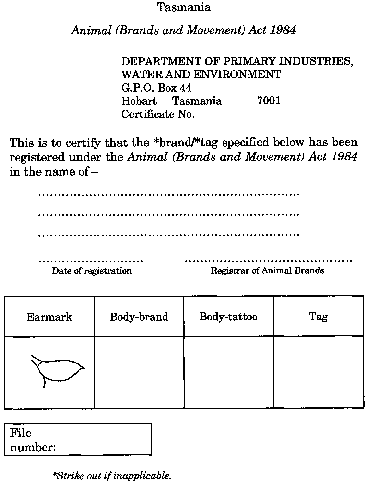
Form 2 - CERTIFICATE OF TRANSFER OF RIGHT TO USE REGISTERED BRAND OR REGISTERED TAG

Form 3 - APPLICATION FOR ISSUE OF DUPLICATE CERTIFICATE OF REGISTRATION OF BRAND OR TAG

SCHEDULE 2 - Nature and dimensions of earmarks for cattle and sheep


SCHEDULE 3 - Designs of brands for cattle, sheep or pigs

SCHEDULE 4 - Tagging cattle for slaughter or sale
1. Prescribed tagsFor the purposes of regulation 17 , the prescribed tag for cattle of a kind specified in any item of the following table is a tag that –(a) is of the kind specified, in respect of those cattle, in column 3 of the table; and(b) [Schedule 4 Amended by S.R. 2006, No. 4, Applied:15 Feb 2006] complies with the special requirements specified, in respect of that kind of tag, in column 4 of the table.[Schedule 4 Amended by S.R. 2006, No. 148, Applied:27 Dec 2006]
Column 1
Item
Column 2
Kind of cattle
Column 3
Kind of tag
Column 4
Special requirements
1.
Calves under 6 weeks old that are –
One of the following tags:
The white plastic ear tag must show the property identification code for the property where the cattle were last normally kept.
(a) unaccompanied by their dam; and
(a) A white plastic ear tag approximately 75mm long and 11mm wide;
(b) being sent –
(b) A permanent identification device approved under the NLIS for cattle
(i) directly to a licensed meat premises; or
(ii) directly to a public saleyard for the purposes of sale and immediate transfer to a licensed meat premises
2.
Mature bulls, other than those identified with a permanent identification device approved under the NLIS for cattle, that are sent directly to a licensed meat premises for slaughter
One of the following transaction tags:
The transaction tag must show the property identification code for the property where the cattle were last normally kept and –
(a) a self-adhesive wrap-around tail tag at least 195mm long and 25mm wide;
(a) if the cattle have been or may have been treated with hormonal growth promotants, be yellow in colour; or
(b) a plastic ratchet tail tag at least 25mm wide;
(b) if the cattle have not been treated with hormonal growth promotants, be pink in colour and be marked "HGP-free".
(c ) a plastic ear tag at least 57mm long and 40mm wide
3.
Any other cattle
(a) A permanent identification device approved under the NLIS; and
(b) if the cattle have been treated with hormonal growth promotants, or it is not known whether or not the cattle have been so treated, one of the following transaction tags:
The transaction tag must be yellow in colour and show the property identification code for the property where the cattle were last normally kept and –
(i) a self-adhesive wrap-around tail tag at least 195mm long and 25mm wide;
(ii) a plastic ratchet tail tag at least 25mm wide;
(iii) a plastic ear tag at least 57mm long and 40mm wide
2. InterpretationIn this Schedule –AQIS means the Australian Quarantine and Inspection Service;European Union Cattle Accreditation Scheme means the accreditation scheme of that name administered by AQIS;EU-listed abattoir means an abattoir approved by AQIS to process meat for the European Union market;hormonal growth promotants means a veterinary chemical product containing a substance that is, or a mixture of substances that are, responsible for oestrogenic, androgenic or gestagenic activity to enhance growth or production in bovines or bubalines;licensed meat premises means licensed meat premises, within the meaning of the Meat Hygiene Act 1985 ;[Schedule 4 Amended by S.R. 2006, No. 4, Applied:15 Feb 2006] [Schedule 4 Amended by S.R. 2006, No. 148, Applied:27 Dec 2006] [Schedule 4 Amended by S.R. 2006, No. 4, Applied:15 Feb 2006] [Schedule 4 Amended by S.R. 2006, No. 148, Applied:27 Dec 2006][Schedule 4 Amended by S.R. 2006, No. 4, Applied:15 Feb 2006] transaction tag means a tail tag or an ear tag other than –(a) a permanent identification device; and(b) an emergency tag referred to in regulation 17(3) ;[Schedule 4 Amended by S.R. 2006, No. 4, Applied:15 Feb 2006] transaction tag exemption means an exemption signed by the Chief Veterinary Officer from the requirement to attach a transaction tag to any cattle.
SCHEDULE 5 - Infringement notice offences[Schedule 5 Amended by S.R. 2006, No. 4, Applied:15 Feb 2006] [Schedule 5 Amended by S.R. 2006, No. 148, Applied:27 Dec 2006]
Column 1 | Column 2 Section/ Regulation | Column 3 General description of offence | Column 4 Penalty units | 1. | Failing to brand cattle or sheep with a registered earmark before they have attained the age of 6 months | 0.5 | 2. | Failing to brand pigs with a registered body-tattoo within 7 days before selling them or sending them to be slaughtered | 0.5 | 3. | Sections 11(13) , (14) or (15) | Failing to apply for registration of earmark, body-tattoo or body-brand | 0.5 | 4. | Failing to immediately notify Registrar that there is no further requirement for use of registered brand or tag | 0.5 | 5. | Knowingly giving evidence or making a statement that is false or misleading | 0.5 | 6. | Branding cattle or sheep with a registered earmark that – | 0.5 | (a) does not comply with the required nature and dimensions; and | (b) is branded in the wrong place | 7. | Branding the prescribed ear of cattle or sheep with an earmark other than the registered earmark of which their owner is the proprietor | 0.5 | 8. | Failing to mark the ear of cattle or sheep as prescribed | 0.5 | 9. | Branding cattle or sheep with a registered body-brand that is not of the prescribed nature and dimensions | 0.5 | 10. | Person branding sheep with a preparation not prescribed | 0.5 | 11. | Butcher branding sheep with a preparation not prescribed | 0.5 | 12. | Failure by keeper to brand impounded cattle, sheep or pigs before delivery to purchaser | 0.5 | 13. | Failing to attach registered tag to cattle as prescribed | 0.5 | 13A. | Failing to attach or insert a permanent identification device as required by a Gazette notice | 1.0 | 13B. | Attaching, inserting, altering or removing a permanent identification device without permission under section 22B | 1.0 | 13C. | Making a false representation as to whether or not any animal has a permanent identification device attached or inserted | 1.0 | 14. | Obstructing, hindering, delaying, threatening or assaulting an inspector | 0.5 | 15. | Failing to comply with a request of, or answer questions asked by, an inspector | 0.5 | 16. | Failing to comply with requirements relating to waybills | 0.5 | 17. | Failing to comply with the prescribed requirements after receiving a mustering notice | 0.5 | 18. | Failing to tag cattle for identification purposes in the prescribed manner | 0.5 | 19. | Person in charge of stock at place of origin failing to provide a vendor declaration as required | 0.5 | 20. | Person required by notice to provide copy of vendor declaration failing to comply with notice | 0.5 | 21. | Person in charge of animals at place of origin failing to provide a movement record as required | 0.5 | 22. | Person required by notice to provide copy of movement record failing to comply with notice | 0.5 | 23. | Person in charge of cattle at destination failing to provide prescribed information to the NLIS database as required | 0.5 | 24. | Person in charge of licensed meat premises failing to provide prescribed information to the NLIS database as required | 0.5 | 25. | Person holding show or sporting event failing to provide prescribed information to the NLIS database as required | 0.5 | 26. | Person selling cattle on behalf of owner at public cattle auction failing to provide arrival report to the NLIS database as required | 0.5 | 27. | Person holding public scale operation failing to provide arrival report to the NLIS database as required | 0.5 | 28. | Person selling cattle on behalf of owner at public cattle auction failing to provide departure report to the NLIS database as required | 0.5 | 29. | Person holding public scale operation failing to provide departure report to the NLIS database as required | 0.5 |
Displayed and numbered in accordance with the Rules Publication Act 1953.
Notified in the Gazette on 10 December 2003
These regulations are administered in the Department of Primary Industries, Water and Environment.