

Petroleum (Submerged Lands) (Occupational Health and Safety) Regulations 2008
I, the Governor in and over the State of Tasmania and its Dependencies in the Commonwealth of Australia, acting with the advice of the Executive Council, make the following regulations under the Petroleum (Submerged Lands) Act 1982 .
16 June 2008PETER G. UNDERWOOD
Governor
By His Excellency's Command,
D. E. LLEWELLYN
Minister for Energy and Resources
PART 1 - Preliminary
These regulations may be cited as the Petroleum (Submerged Lands) (Occupational Health and Safety) Regulations 2008 .
These regulations take effect on the day on which the Petroleum (Submerged Lands) Amendment Act 2004 commences.
The object of these regulations is to prescribe matters related to occupational health and safety on offshore petroleum facilities.
(1) In these regulations, unless the contrary intention appears –Act means the Petroleum (Submerged Lands) Act 1982 ;Commonwealth regulations means the Petroleum (Submerged Lands) (Occupational Health and Safety) Regulations 1993 of the Commonwealth;Commonwealth waters has the meaning given by the Commonwealth Act;controlled substance means a substance mentioned in –(a) Schedule 8 to the Customs (Prohibited Exports) Regulations 1958 of the Commonwealth; or(b) Schedule 4 to the Customs (Prohibited Imports) Regulations 1956 of the Commonwealth;designated work group has the meaning given by clause 2 of Schedule 5 to the Act;election means an election for a health and safety representative or a deputy health and safety representative under clause 23 or 30 of Schedule 5 to the Act;employer has the meaning given by clause 2 of Schedule 5 to the Act;facility has the meaning given by clause 2 of Schedule 5 to the Act;health and safety representative means a person selected as a health and safety representative for a designated work group under clause 22 of Schedule 5 to the Act;identity card means an identity card issued under the Commonwealth Act to an OHS inspector;intoxicant means a beverage or other substance for human consumption that contains alcohol (other than a substance for medical or pharmaceutical use);member of the workforce, in relation to a facility, has the meaning given by clause 2 of Schedule 5 to the Act;operator has the meaning given by clause 2 of Schedule 5 to the Act;[Regulation 4 Subregulation (1) amended by No. 3 of 2010, Sched. 1, Applied:01 Jul 2010][Regulation 4 Subregulation (1) amended by No. 3 of 2010, Sched. 1, Applied:01 Jul 2010] pharmacist means a person who is registered under the Health Practitioner Regulation National Law (Tasmania) in the pharmacy profession;returning officer means a person appointed as a returning officer under regulation 14 ;therapeutic drug means a drug that –(a) [Regulation 4 Subregulation (1) amended by No. 3 of 2010, Sched. 1, Applied:01 Jul 2010] may be prescribed by a medical practitioner; or(b) [Regulation 4 Subregulation (1) amended by No. 3 of 2010, Sched. 1, Applied:01 Jul 2010] may be sold without a prescription prepared by a medical practitioner;voter means a person who is eligible to vote in an election;work has the meaning given by clause 2 of Schedule 5 to the Act;workplace has the meaning given by clause 2 of Schedule 5 to the Act.(2) A reference in these regulations to a form by number is a reference to the form so numbered in Schedule 1 .
Note: The following expressions are defined in section 3 of the Act and have the same meaning in these regulations:
(a) Commonwealth Act
(b) OHS inspector
(c) Safety Authority
5. Relationship with other regulations made under Act
The requirements of these regulations are in addition to the requirements imposed on a person by any other regulations made under the Act.
(1) A form is to be completed in accordance with a direction specified in, or at the foot of, the form.(2) A person who is required for the purposes of the Act or these regulations –is to complete the form, give notice or make the report in sufficient detail to allow proper consideration of the form, notice or report.(a) to complete a form; or(b) to give notice or make a report –(3) A form, notice or report is to be produced clearly and legibly in handwriting or by means of a machine in such a manner as to enable clear and legible reproduction of the contents of the form, notice or report.
PART 2 - Regulations Relating to Health and Safety
(1) This regulation applies to a person who is –(a) an operator; or(b) an employer; or(c) another person in control of –(i) a facility; or(ii) a part of a facility; or(iii) particular work carried out at a facility.(2) The person must not allow, or require, a member of the workforce who is under the person’s control, to work for –of a duration that could reasonably be expected to have an adverse effect on the health or safety of the member of the workforce or other persons at or near the facility.(a) a continuous period; or(b) successive continuous periods –
8. Possession or control of drugs or intoxicants
(1) A person on a facility must not have possession or control of –(a) a controlled substance; or(b) an intoxicant.(2) It is a defence in proceedings for an offence under subregulation (1)(a) if the defendant establishes that –(a) the person had possession or control of a controlled substance that is a therapeutic drug; and(b) the person had the therapeutic drug in his or her possession or control –(i) in the course of the person’s employment; or(ii) [Regulation 8 Subregulation (2) amended by No. 3 of 2010, Sched. 1, Applied:01 Jul 2010] in the course of the person’s duties or practice as a medical practitioner, a registered nurse or a pharmacist; or(iii) in accordance with the law of this State; or(iv) if the person had lawfully acquired the therapeutic drug, for the person’s bona fide personal use.
9. Person to leave facility when instructed
(1) A person on a facility must leave the facility if instructed to do so by a person in control of the facility.(2) An instruction –(a) in the case of an emergency, may be given orally; or(b) in any other case relevant to occupational health and safety on the facility –(i) must be in writing; and(ii) must include the reason for the instruction.
10. Prohibition on use of certain hazardous substances
(1) This regulation applies to a person who is–(a) an operator; or(b) an employer; or(c) another person in control of –(i) a facility; or(ii) a part of a facility; or(iii) particular work carried out at a facility.(2) The person must not allow a hazardous substance, referred to in column 2 of an item in Part 2 or 3 of Schedule 2 , to be used in any circumstance other than a circumstance specified in column 3 of the item.(3) It is a defence in proceedings for an offence under subregulation (2) if the defendant establishes that the use is in accordance with an exemption granted by the Safety Authority under regulation 13 .(4) Subregulation (2) does not apply to the use of chrysotile asbestos if the use is permitted under regulation 4D(5) of the Commonwealth regulations in relation to a facility in Commonwealth waters.
11. Limitations on exposure to certain hazardous substances
(1) This regulation applies to a person who is –(a) an operator; or(b) an employer; or(c) another person in control of –(i) a facility; or(ii) a part of a facility; or(iii) particular work carried out at a facility.(2) The person must not allow a member of the workforce who is under the person’s control to be exposed to an airborne concentration of a hazardous substance in the breathing zone of the member of the workforce at a level that exceeds the appropriate exposure standard for the relevant period of time.(3) It is a defence in proceedings for an offence under subregulation (2) if the defendant establishes that the airborne concentration of the hazardous substance in the breathing zone of the member of the workforce is in accordance with an exemption given by the Safety Authority under regulation 13 .(4) In this regulation –appropriate exposure standard means an airborne concentration for a substance as set out in the Adopted National Exposure Standards for Atmospheric Contaminants in the Occupational Environment [NOHSC:1003(1995)] published by the National Occupational Health and Safety Commission, as in force from time to time;hazardous substance has the meaning given in regulation 4E of the Commonwealth regulations.
(1) This regulation applies to a person who is–(a) an operator; or(b) an employer; or(c) another person in control of –(i) a facility; or(ii) a part of a facility; or(iii) particular work carried out at a facility.(2) The person must not allow a member of the workforce who is under the person’s control to be exposed to a level of noise that is in excess of the noise exposure standard.(3) However, it is not an offence for a person to allow a member of the workforce who is under the person’s control to be exposed to a level of noise that exceeds the noise exposure standard if –(a) noise exposure is managed in a manner consistent with the provisions of the National Code of Practice for Noise Management and Protection of Hearing at Work [NOHSC: 2009 (2004)], as in force from time to time; and(b) after allowing for the protection offered by hearing protectors, the level of noise exposure is less than –(i) an LAeq,8h, of 85dB(A); or(ii) an LC,peak, of 140dB(C).(4) Subregulation 3(b) applies despite the wording of the noise exposure standard.(5) It is a defence in proceedings for an offence under subregulation (2) if the defendant establishes that the level of noise to which the member of the workforce is exposed is in accordance with an exemption given by the Safety Authority under regulation 13 .(6) In this regulation –noise exposure standard means the noise exposure standard set out in the National Standard for Occupational Noise [NOHSC: 1007(2000)] published by the National Occupational Health and Safety Commission, as in force from time to time.
13. Exemptions from hazardous substances and noise requirements
(1) This regulation applies to a person who is –(a) an operator; or(b) an employer; or(c) another person in control of –(i) a facility; or(ii) a part of a facility; or(iii) particular work carried out at a facility.(2) A person to whom this regulation applies may apply to the Safety Authority for an exemption from compliance with regulation 10(2) , 11(2) or 12(2) .(3) The Safety Authority may grant an exemption if it considers that, in specified circumstances, compliance is not practicable.(4) The Safety Authority may specify conditions and limitations on an exemption.
PART 3 - Election of Health and Safety Representatives
Division 1 - Returning officer
14. Appointment of returning officer
(1) If, under clause 23(3) of Schedule 5 to the Act, an operator is required to conduct an election, or arrange for the conduct of an election, the operator must nominate a person to act as the returning officer for the election.(2) The operator must notify the Safety Authority of the nomination.(3) The Safety Authority may –(a) approve the nomination and appoint the nominee as returning officer; or(b) appoint another person as returning officer.
Division 2 - The poll
Each voter is entitled to one vote only in the election.
A voter may request the returning officer for the election to conduct the poll for the election by secret ballot.
17. Conduct of poll by secret ballot
(1) As soon as practicable after a request under regulation 16 is made, the returning officer is to issue ballot-papers for the poll to voters.(2) The returning officer is to conduct the poll in accordance with Divisions 3 and 4 .
18. Conduct of poll if no request made for secret ballot
Subject to Division 5 , if no request is made for a secret ballot, the returning officer for an election may conduct a poll for the election in a manner determined by him or her to produce a fair result.
19. If no candidate is elected
If, in an election, no candidate is elected, the election is taken to have failed.
Division 3 - Polling by secret ballot
A ballot-paper must –(a) state the election to which it relates; and(b) set out the names of the candidates in alphabetical order; and(c) state the manner of voting.
21. Distribution of ballot papers
(1) As soon as practicable before the close of a poll by secret ballot, the returning officer for an election is to give to each voter –(a) a ballot-paper that is initialled by the returning officer; and(b) an envelope that –(i) is addressed to the returning officer; and(ii) shows on its face that it relates to the election.(2) The envelope given to a voter by a returning officer –(a) may be pre-paid as to postage; and(b) in that case, may include on its face a statement by the returning officer that the envelope may be posted to the returning officer without expense to the voter.(3) The returning officer is to ensure that the ballot-paper and envelope are enclosed in a covering envelope that is sealed and addressed to the voter.
22. Manner of voting by secret ballot
(1) A voter in a poll by secret ballot is to mark the ballot-paper to indicate his or her preference by placing the number 1 in the box printed opposite the name of the candidate for whom that person wishes to vote.(2) After marking the ballot-paper, the voter must –(a) fold the ballot-paper so as to conceal the marking; and(b) put the ballot-paper in the envelope referred to in regulation 21(1)(b) and seal the envelope; and(c) lodge the ballot by –(i) putting the envelope containing the ballot-paper in a locked and sealed ballot box, provided for the election by the returning officer, in a secure part of the workplace where the members of the workforce in the designated work group to which the election relates may place envelopes of that kind; or(ii) sending the envelope to the returning officer so as to reach him or her not later than the close of the poll.(3) If, before lodging his or her ballot, a voter –(a) claims that he or she has spoilt his or her ballot-paper; and(b) returns the ballot-paper to the returning officer; and(c) requests a further ballot-paper –the returning officer must –(d) give the voter a fresh ballot-paper; and(e) write the word "spoilt" across the returned ballot-paper and sign and date the writing; and(f) retain the spoilt ballot-paper until the end of 6 months after notification of the result of the poll is given under regulation 33 .
Division 4 - The count
23. Envelopes given to returning officer
(1) A returning officer for an election must –(a) keep secure the ballots received by him or her before the close of the poll; and(b) keep the envelopes containing the ballot-papers unopened until the count.(2) The returning officer must not admit to the count ballot-papers received by him or her after the close of the poll.
Each candidate in a poll conducted by secret ballot may appoint one scrutineer to represent him or her at the count.
25. Returning officer to be advised of scrutineers
A candidate is to tell the returning officer for the election the name of his or her scrutineer (if any) before the commencement of the count.
(1) The returning officer for an election may direct a person to leave the place where the count is being conducted if the person –(a) is not entitled to be present, or to remain present, at the count; or(b) being entitled to be present, interrupts the count, except as provided by subregulation (2) .(2) A candidate’s scrutineer may interrupt the count and so inform the returning officer if the scrutineer –(a) objects to a decision by the returning officer that a ballot paper is formal or informal, as the case may be; or(b) considers that an error has been made in the conduct of the count.(3) A person must comply with a direction given to him or her under subregulation (1) .(4) However, it is a defence in proceedings for an offence under subregulation (3) if the defendant establishes that he or she has a reasonable excuse.
(1) As soon as practicable after the close of the poll, the returning officer is to count the votes for each candidate.(2) A scrutineer, appointed under regulation 24 , may be present at the count.(3) A returning officer must, as soon as practicable before the count, notify each candidate, or a scrutineer of each candidate, of the place where, and the time when, the count is to occur.(4) The candidate who receives the most votes is the successful candidate.(5) If 2 or more candidates receive the same number of votes, the successful candidate is to be determined by lots drawn by the returning officer.
A ballot-paper is informal if –(a) it is not initialled by the returning officer; or(b) it has no vote marked on it; or(c) it is so imperfectly marked that the intention of the person who marked the ballot-paper is not clear; or(d) it has any mark or writing on it by which the person who marked the ballot-paper can be identified.
After the count conducted in respect of a poll has been completed, the returning officer is to prepare, date and sign a statement setting out –(a) the number of valid votes given to each candidate; and(b) the number of informal ballot-papers.
30. Destruction of election material
At the end of the 6-month period commencing on the day after notification of the result of the poll for an election is given under regulation 33 , the returning officer may destroy –(a) the nominations for that election; and(b) the ballot-papers, including any spoilt ballot-papers, for the election.
Division 5 - Result of election
(1) At any time before notification of the result of the poll for an election is given under regulation 33 , the returning officer –(a) on his or her own initiative, may conduct a recount of any ballot-papers received in the election; or(b) if a candidate makes a request, either orally or in writing, for a recount of any ballot-papers received in the election and gives reasons for the request, is to conduct a recount of the ballot-papers.(2) In conducting a recount, the returning officer –(a) in the case of a poll by secret ballot, has the same powers for the purposes of the recount as he or she had in the count; and(b) in any other case, may make any reasonable decision in respect of the allowance and admission, or disallowance and rejection, of a vote cast in the poll.
32. Irregularities at election
(1) Subject to subregulation (2) , if the returning officer has reasonable grounds to believe that there has been an irregularity in the conduct of an election, he or she may, at any time before notification of the result of the poll is given under regulation 33 , declare the election to be void.(2) An election is not to be declared to be void only because of –(a) a defect or irregularity in the conduct of the election that did not affect the result of the election; or(b) an error or defect in an instrument or other document made, or purporting to be made, for the purposes of this Part; or(c) an illegal practice, other than bribery or corruption, or attempted bribery or corruption, having been engaged in by a person, unless –(i) it is likely that the result of the election was affected by the practice; and(ii) it is just that the election be declared void.(3) If an election is declared void, regulation 33 applies as if the election had failed.
(1) As soon as practicable after the failure of an election, a returning officer is to notify in writing –of the failure of the election.(a) the operator of the facility to which the election relates; and(b) the Safety Authority –(2) As soon as practicable after the close of the poll for an election that has not failed, the returning officer is to notify in writing the candidate who is elected and enclose with the notification a copy of the statement prepared under regulation 29 .
PART 4 - Advice, Investigations and Inquiries
34. Taking samples for testing, &c.
(1) If a sample of a substance or thing taken under clause 54(1) of Schedule 5 to the Act is safely and practicably divisible, the OHS inspector who has taken the sample is to –(a) divide the sample into 3 parts; and(b) put each part into a container and seal and label the container appropriately; and(c) give one part to the operator or the employer for whom the substance or thing was being used; and(d) provide another part for inspection, examination, measuring or testing for the purposes of Schedule 5 to the Act; and(e) retain the remaining part for any further inspection, examination, measuring or testing that is required.(2) If a sample of a substance or thing taken under clause 54(1) of Schedule 5 to the Act is not safely and practicably divisible, the OHS inspector who has taken the sample must provide the whole sample for inspection, examination, measuring or testing for the purposes of the Schedule.(3) An OHS inspector who, under clause 54(1) of Schedule 5 to the Act –(a) has taken possession of any plant, substance or thing; or(b) has taken a sample of a substance or thing –and removed the plant, substance or thing or the sample from the workplace is to take all reasonable steps to ensure that, while in his or her possession or control –(c) the plant, substance or thing is not damaged; or(d) the sample is not contaminated.
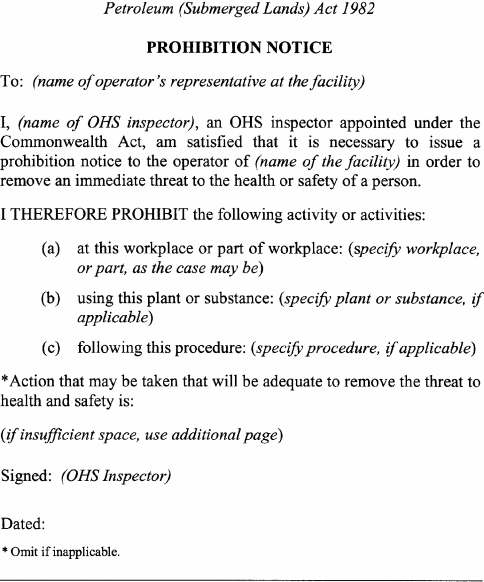
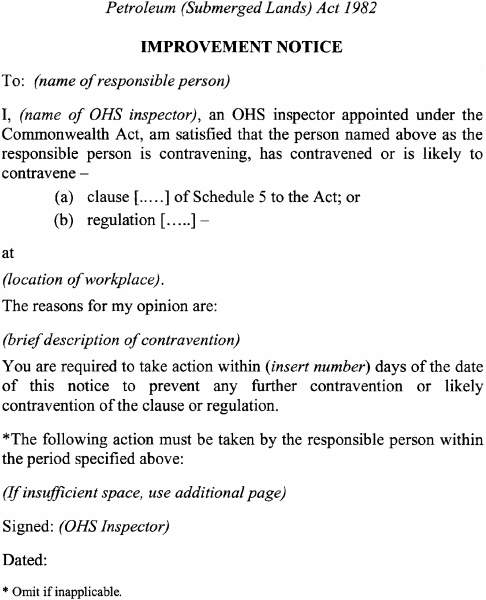
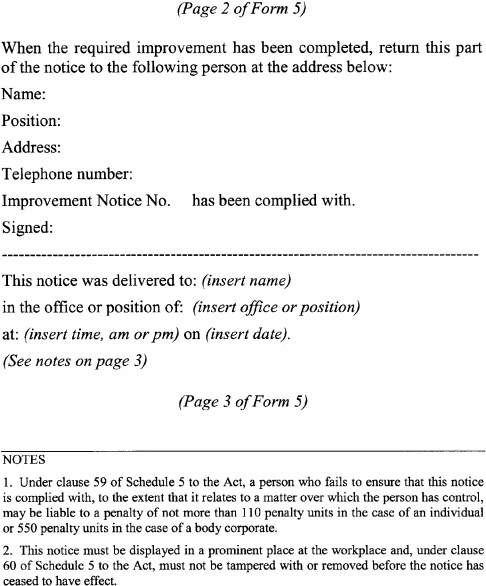
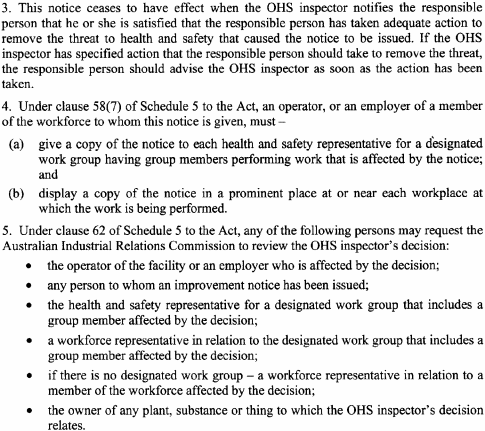
A notice issued by an elected health and safety representative or OHS inspector under any of the following provisions of Schedule 5 to the Act must be in accordance with the form specified in relation to the provision concerned:(a) clause 35(2) (provisional improvement notices) – Form 1 ;(b) clause 54(2) (power to take possession of plant, take samples of substances etc) – Form 2 ;(c) clause 55(2) (power to direct that workplace etc not be disturbed) – Form 3 ;(d) clause 56(1) (power to issue prohibition notices) – Form 4 ;(e) clause 58(1) (power to issue improvement notices) – Form 5 .
PART 5 - Exemptions from Requirements in Part 3 of Schedule 5 to Act
36. Orders under clause 43 of Schedule 5 to Act
(1) For the purposes of clause 43(1) of Schedule 5 to the Act, a person may apply in writing to the Safety Authority for an order exempting the person from one or more of the provisions of Part 3 of the Schedule.(2) Within 28 days after the Safety Authority receives an application, the Safety Authority is to decide whether or not to make the order.(3) In making the decision, the Safety Authority is to –(a) consult with persons who might be affected by the decision to grant or refuse an exemption; and(b) take into account submissions made by those persons.
Note: Examples are –
Example 1: If an operator applies for an exemption, a health and safety representative might be an affected person.
Example 2: If a health and safety representative applies for an exemption, an operator might be an affected person.
(4) In granting an exemption, the Safety Authority –(a) may grant the exemption subject to conditions; and(b) may specify a period of time during which the exemption applies.(5) The Safety Authority is to give reasons for the decision.
PART 6 - State Laws that do not Apply
37. Laws or parts of laws that do not apply
For the purposes of section 14A of the Act, the following laws are prescribed:(a) the Dangerous Goods Act 1998 ;(b) the Electricity Industry Safety and Administration Act 1997 ;(c) the Gas Act 2000 to the extent that it relates to occupational health and safety;(d) the Gas Pipelines Act 2000 to the extent that it relates to occupational health and safety;(e) [Regulation 37 Amended by No. 2 of 2012, s. 46, Applied:01 Jan 2013] the Work Health and Safety Act 2012 .
PART 7 - Miscellaneous
(1) For the purposes of Schedule 5 to the Act and these regulations, a notice that is to be given to a body corporate may be given to a director, principal executive officer or secretary of the body corporate.(2) For the purposes of Schedule 5 to the Act and these regulations, a notice or report may be given to a person –(a) by electronic facsimile message transmitted to a facsimile facility that is installed at the address of the person last known to the person transmitting the message; and(b) by a message transmitted to a computer system that is known to be in use by the person and installed at the address of the person last known to the person transmitting the message, being a message that is –(i) in a form compatible with the computer system; and(ii) capable of being recorded by the computer system.(3) A person who gives a notice or report to which subregulation (2) applies to another person –(a) must inform the other person by telephone –of the fact that the message will be, or has been, transmitted; and(i) before transmission of the message; or(ii) as soon as practicable after transmission of the message –(b) is to send a copy of the notice or report by pre-paid post to the address of the other person last known to the first-mentioned person.
SCHEDULE 1 - Forms
Form 1
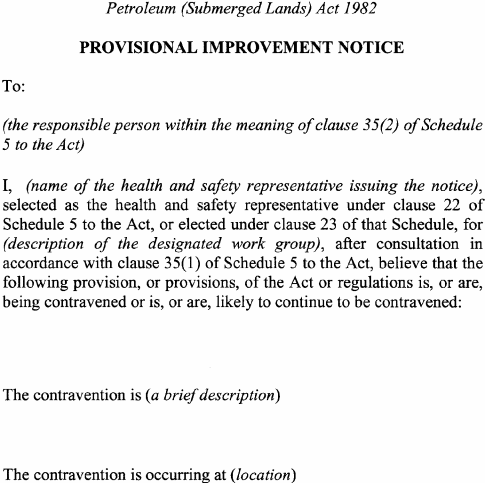
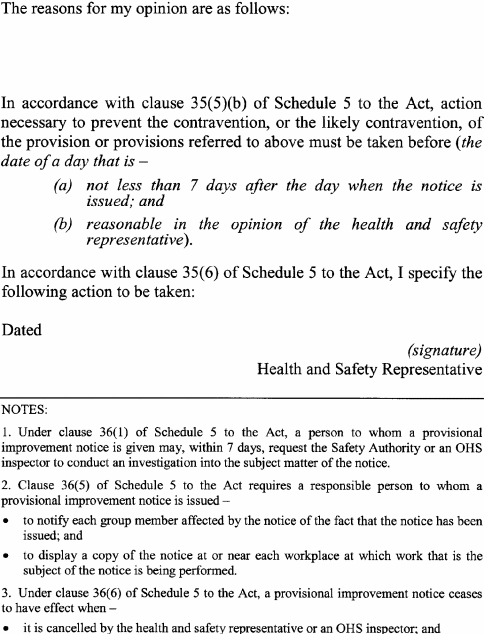
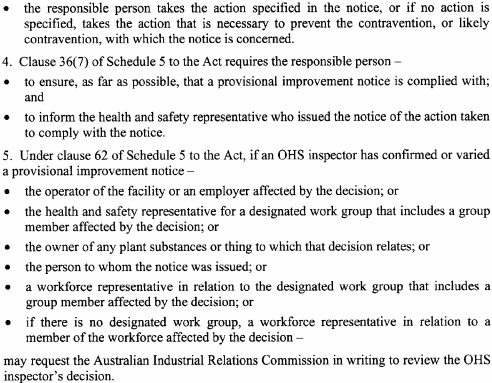
Form 2
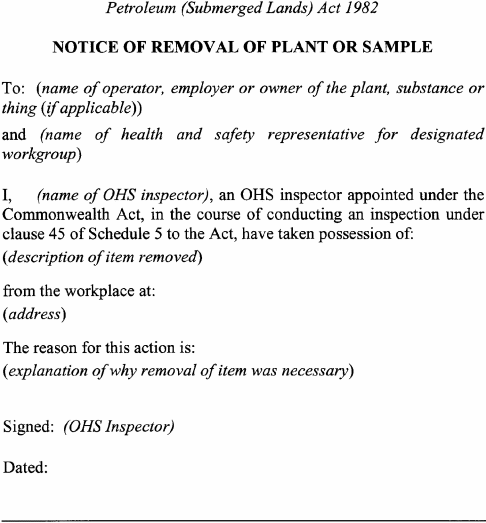
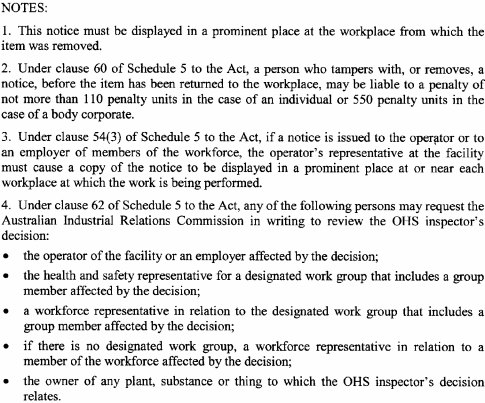
Form 3
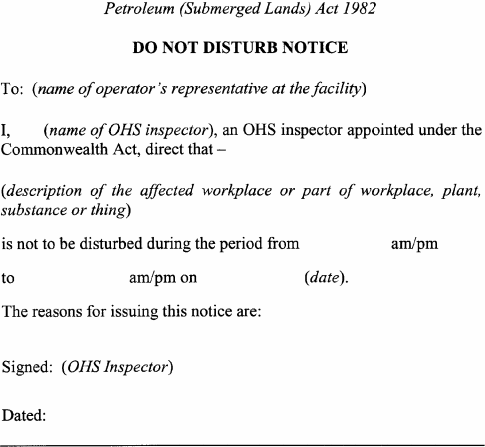
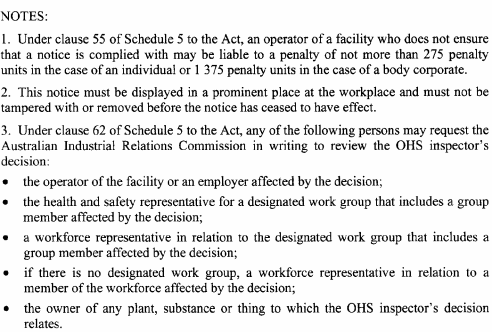
Form 4
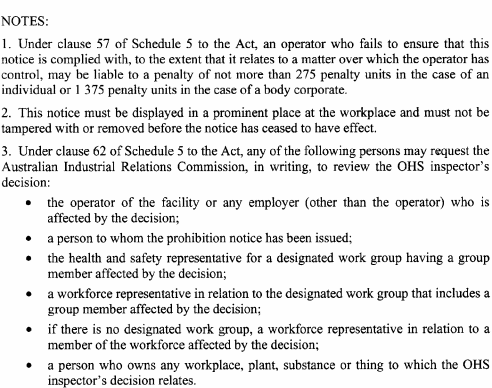
Form 5
SCHEDULE 2 - Hazardous Substances
PART 1 - Interpretation
1. In this Schedule –bona fide research means a systematic, investigative or experimental activity conducted for the purpose of –(a) acquiring new knowledge; or(b) creating new or improved materials, products, devices, processes or services; or(c) analysis to identify the kind or quantities of ingredients in a substance;in situ, in relation to a product that contains asbestos, means that, at the time the use of the form of asbestos in the product is prohibited under regulation 10 , the product is fixed or installed –(a) in –(i) a building or any other structure that forms a workplace; or(ii) a plant, a vehicle or any other thing that is for use at a workplace; and(b) in a way that does not constitute a risk to users until the asbestos contained in the product is disturbed.
PART 2 - Permitted Circumstances for Using Certain Hazardous Substances
Column 1 Item | Column 2 Substance (identified by substance name) | Column 3 Permitted circumstance | 1. | Polychlorinated biphenyls (also known as PCBs) | 1 Handling for storage prior to removal or disposal. | 2 Storage prior to removal or disposal. | 3 Removal or disposal. | 4 Use when contained in existing electrical equipment or construction material. | 5 Repair of existing electrical equipment or construction material. |
PART 3 - Permitted Circumstances for Using Certain Hazardous Substances with Carcinogenic Properties
Column 1 Item | Column 2 Substance (identified by substance name, with chemical abstract number in square brackets) | Column 3 Permitted circumstance | 1. | 2-Acetylaminofluorene [53-96-3] | Bona fide research | 2. | Aflatoxins | Bona fide research | 3. | 4-Aminodiphenyl [92-67-1] | Bona fide research | 4. | Amosite (brown asbestos) [12172-73-5] | 1 Bona fide research. | 2 Handling for storage prior to removal or disposal of amosite. | 3 Storage prior to removal or disposal of amosite. | 4 Removal or disposal of amosite in accordance with a law of a State or Territory relating to the removal of asbestos. | 5 Disturbance of naturally occurring amosite that is incidental to operations not related to the extraction or processing of amosite, for example, roadworks. | 6 Use (without disturbance) of amosite in products that are in situ. | 5. | Benzidine [92-87-5] and its salts, including benzidine dihydrochloride [531-85-1] | Bona fide research | 6. | bis (chloromethyl) ether [542-88-1] | Bona fide research | 7. | Chloromethyl methyl ether (technical grade containing bis (chloromethyl) ether) [107-30-2] | Bona fide research | 8. | Crocidolite (blue asbestos) [12001-28-4] | 1 Bona fide research. | 2 Handling for storage prior to removal or disposal of crocidolite. | 3 Storage prior to removal or disposal of crocidolite. | 4 Removal or disposal of crocidolite in accordance with a law of a State or Territory relating to the removal of asbestos. | 5 Disturbance of naturally occurring crocidolite that is incidental to operations not related to the extraction or processing of crocidolite, for example, roadworks. | 6 Use (without disturbance) of crocidolite in products that are in situ. | 9. | 4-Dimethylaminoazo-benzene [60-11-7] | Bona fide research | 10. | 2-Naphthylamine [91-59-8] and its salts | Bona fide research | 11. | 4-Nitrodiphenyl [92-93-3] | Bona fide research | 12. | Actinolite asbestos [77536-66-4] | 1 Bona fide research. | 2 Handling for storage prior to removal or disposal of actinolite. | 3 Storage prior to removal or disposal of actinolite. | 4 Removal or disposal of actinolite in accordance with a law of a State or Territory relating to the removal of asbestos. | 5 Disturbance of naturally occurring actinolite that is incidental to operations not related to the extraction or processing of actinolite, for example, roadworks. | 6 Use (without disturbance) of actinolite in products that are in situ. | 13. | Anthophyllite asbestos [77536-67-5] | 1 Bona fide research. | 2 Handling for storage prior to removal or disposal of anthophyllite. | 3 Storage prior to removal or disposal of anthophyllite. | 4 Removal or disposal of anthophyllite in accordance with a law of a State or Territory relating to the removal of asbestos. | 5 Disturbance of naturally occurring anthophyllite that is incidental to operations not related to the extraction or processing of anthophyllite, for example, roadworks. | 6 Use (without disturbance) of anthophyllite in products that are in situ. | 14. | Chrysotile (white asbestos) [12001-29-5] | 1 Bona fide research. | 2 Handling for storage prior to removal or disposal of chrysotile. | 3 Storage prior to removal or disposal of chrysotile. | 4 Removal or disposal of chrysotile in accordance with a law of a State or Territory relating to the removal of asbestos. | 5 Disturbance of naturally occurring chrysotile that is incidental to operations not related to the extraction or processing of chrysotile, for example, roadworks. | 6 Use (without disturbance) of chrysotile in products that are in situ. | 15. | Tremolite asbestos [77536-68-6] | 1 Bona fide research. | 2 Handling for storage prior to removal or disposal of tremolite. | 3 Storage prior to removal or disposal of tremolite. | 4 Removal or disposal of tremolite in accordance with a law of a State or Territory relating to the removal of asbestos. | 5 Disturbance of naturally occurring tremolite that is incidental to operations not related to the extraction or processing of tremolite, for example, roadworks. | 6 Use (without disturbance) of tremolite in products that are in situ. |
Note: This Part sets out the prohibitions and permitted uses that apply to all Australian workplaces under a national agreement. However, not all items and permitted uses are relevant to offshore petroleum operations. |
Displayed and numbered in accordance with the Rules Publication Act 1953.
Notified in the Gazette on 18 June 2008
These regulations are administered in the Department of Infrastructure, Energy and Resources.